
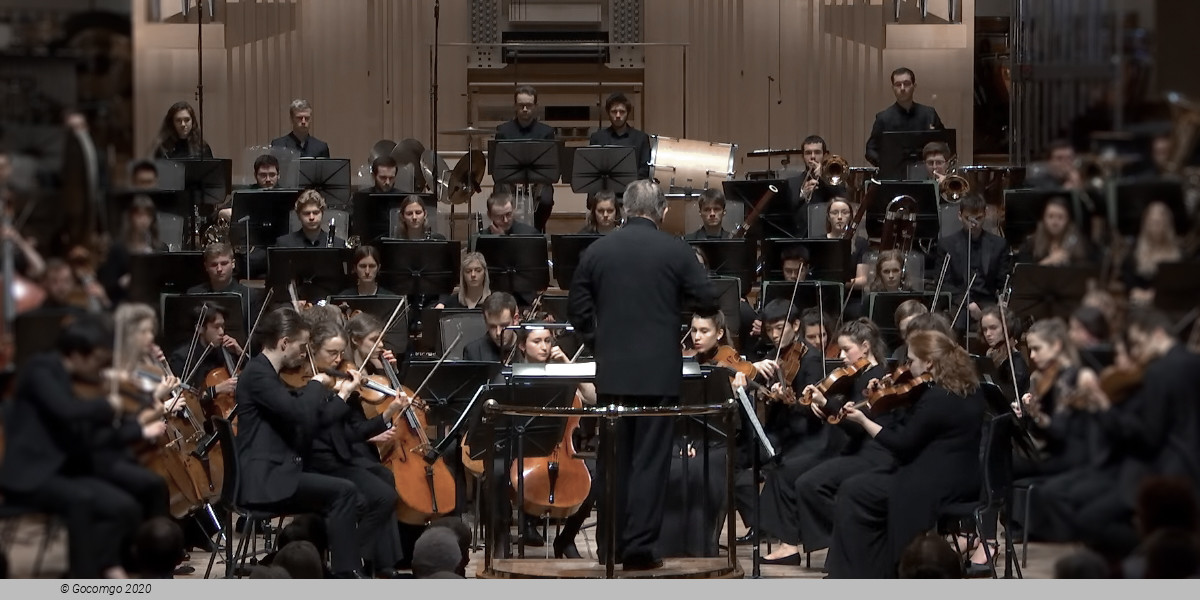
Bavarian State Opera 7 March 2022 - Sabine Devieilhe (soprano) and Bayerisches Staatsorchester. Conductor - Vladimir Jurowski | GoComGo.com

Sabine Devieilhe (soprano) and Bayerisches Staatsorchester. Conductor - Vladimir Jurowski

Bavarian State Opera, National Theatre, Munich, Germany
All photos (1)
Select date and time
8 PM

E-tickets: Print at home or at the box office of the event if so specified. You will find more information in your booking confirmation email.

You can only select the category, and not the exact seats.
If you order 2 or 3 tickets: your seats will be next to each other.
If you order 4 or more tickets: your seats will be next to each other, or, if this is not possible, we will provide a combination of groups of seats (at least in pairs, for example 2+2 or 2+3).

Important Info
Type: Classical Concert
City: Munich, Germany
Starts at: 20:00

E-tickets: Print at home or at the box office of the event if so specified. You will find more information in your booking confirmation email.

You can only select the category, and not the exact seats.
If you order 2 or 3 tickets: your seats will be next to each other.
If you order 4 or more tickets: your seats will be next to each other, or, if this is not possible, we will provide a combination of groups of seats (at least in pairs, for example 2+2 or 2+3).

Programme
Benjamin Britten: Sinfonia da Requiem, Op.20
Benjamin Britten: Les Illuminations, for soprano or tenor and strings, Op.18
Claude Debussy: Pelléas et Mélisande: Suite
Maurice Ravel: La Valse
Overview

Benjamin Britten's first opera, Peter Grimes, is the starting point for the cross-border journey that this concert undertakes; it follows the interests and the biographical situation of the composer in his time. He wrote the Sinfonia da Requiem in 1940 in America, where, as an avowed conscientious objector, he had sought temporary refuge before the Second World War; "I'm making it just as anti-war as possible," he said while composing. Shortly before, his opus 18, Les Illuminations representedfor voice and orchestra based on poems by Arthur Rimbaud, the departure into new realms that Britten would seek during his stay in the USA - here in an expressive, almost surrealistic reaction to the dream images conjured up by the poet. The vocal part will be interpreted by the brilliant soprano Sabine Devieilhe, who celebrated a brilliant debut in the National Theater in 2020 as Queen of the Night. From French poetry, whose tone and intonation Britten took up so sensitively, the step to genuinely French symphonies is not far: the suite from Claude Debussy's only opera Pelléas et Mélisande, put together by the composer Marius Constant. Maurice Ravel, on the other hand, has with La valse Shortly after the end of the First World War, a paraphrase was written about the Viennese waltz - a homage to a lost world in which the admiration for its achievements as well as the horror at its destruction become arousing.

Vladimir Jurowski, born in Moscow, began his musical training at the local conservatory and continued it at the music academies in Berlin and Dresden. He made his international debut in 1995 at the Wexford Festival. Since then he has conducted at the Metropolitan Opera in New York, at the Teatro alla Scala in Milan, at the Opéra national de Paris, at the Bolshoi Theater in Moscow, at the Semperoper in Dresden and at the Salzburg Festival. From 2001 to 2013 he was musical director of the Glyndebourne Festival, since 2007 he has been chief conductor of the London Philharmonic Orchestra. He has also been chief conductor and artistic director of the Berlin Radio Symphony Orchestra (RSB) since 2017. He is also the Principal Artist of the Orchestra of the Age of Enlightenment and Artistic Director of the State Academic Symphony Orchestra of Russia. He has made guest appearances with the Berlin and Vienna Philharmonic and the Koninklijk Concertgebouworkest in Amsterdam. From autumn 2021 he will be general music director of the Bavarian State Opera. (Status: 2021)

Venue Info

Bavarian State Opera - Munich
Location   Max-Joseph-Platz 2

The Bavarian State Opera or the National Theatre (Nationaltheater) on Max-Joseph-Platz in Munich, Germany, is a historic opera house and the main theatre of Munich, home of the Bavarian State Opera, Bavarian State Orchestra, and the Bavarian State Ballet.

During its early years, the National Theatre saw the premières of a significant number of operas, including many by German composers. These included Wagner’s Tristan und Isolde (1865), Die Meistersinger von Nürnberg (1868), Das Rheingold (1869) and Die Walküre (1870), after which Wagner chose to build the Festspielhaus in Bayreuth and held further premières of his works there.

During the latter part of the 19th century, it was Richard Strauss who would make his mark on the theatre in the city in which he was born in 1864. After accepting the position of conductor for a short time, Strauss returned to the theatre to become principal conductor from 1894 to 1898. In the pre-War period, his Friedenstag (1938) and Capriccio were premièred in Munich. In the post-War period, the house has seen significant productions and many world premieres.

First theatre – 1818 to 1823
The first theatre was commissioned in 1810 by King Maximilian I of Bavaria because the nearby Cuvilliés Theatre had too little space. It was designed by Karl von Fischer, with the 1782 Odéon in Paris as architectural precedent. Construction began on 26 October 1811 but was interrupted in 1813 by financing problems. In 1817 a fire occurred in the unfinished building.

The new theatre finally opened on 12 October 1818 with a performance of Die Weihe by Ferdinand Fränzl, but was soon destroyed by another fire on 14 January 1823; the stage décor caught fire during a performance of Die beyden Füchse by Étienne Méhul and the fire could not be put out because the water supply was frozen. Coincidentally the Paris Odéon itself burnt down in 1818.

Second theatre – 1825 to 1943
Designed by Leo von Klenze, the second theatre incorporated Neo-Grec features in its portico and triangular pediment and an entrance supported by Corinthian columns. In 1925 it was modified to create an enlarged stage area with updated equipment. The building was gutted in an air raid on the night of 3 October 1943.

Third theatre – 1963 to present
The third and present theatre (1963) recreates Karl von Fischer's original neo-classical design, though on a slightly larger, 2,100-seat scale. The magnificent royal box is the center of the interior rondel, decorated with two large caryatids. The new stage covers 2,500 square meters (3,000 sq yd), and is thus the world's third largest, after the Opéra Bastille in Paris and the Grand Theatre, Warsaw.

Through the consistent use of wood as a building material, the auditorium has excellent acoustics. Architect Gerhard Moritz Graubner closely preserved the original look of the foyer and main staircase. It opened on 21 November 1963 with an invitation-only performance of Die Frau ohne Schatten under the baton of Joseph Keilberth. Two nights later came the first public performance, of Die Meistersinger von Nürnberg, again under Keilberth.

Important Info
Type: Classical Concert
City: Munich, Germany
Starts at: 20:00
Top of page