Time: The religious wars of the 16th century
Place: Dordrecht and Münster
Precis: Jean de Leyde (based on the historical John of Leiden), whose beloved, Berthe, is coveted by Count Oberthal, ruler of Dordrecht, is persuaded by a trio of sinister Anabaptists to proclaim himself king in Münster.
Meyerbeer originally wrote a long overture for the opera which was cut during rehearsals, along with various other sections of the work, due to the excessive length of the opera itself. For over a century, the overture was thought to survive only in piano arrangements made at Meyerbeer's request by Charles-Valentin Alkan, but Meyerbeer's manuscript full score was rediscovered in the Bibliothèque Nationale in Paris in the early 1990s, the original parts were discovered in the archives of the Paris Opèra shortly thereafter, and a newly edited edition was published in 2010.
Act 1
The countryside around Dordrecht in Holland. At the bottom flows the Meuse. On the right, Oberthal's castle with a drawbridge and turrets; on the left, the farms and mills connected with the castle.
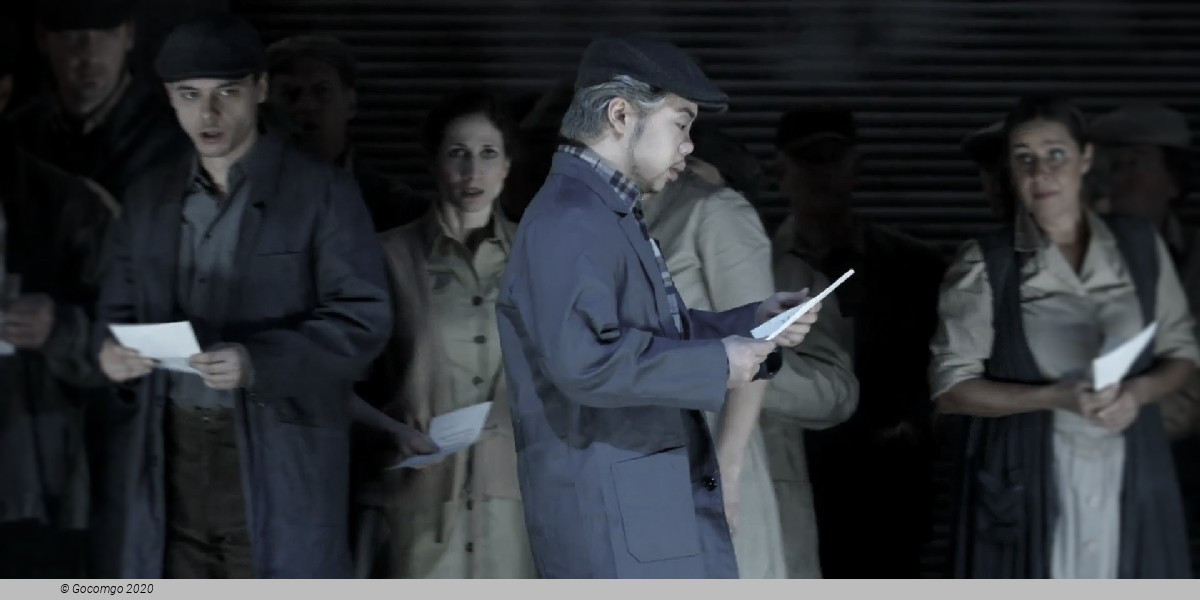
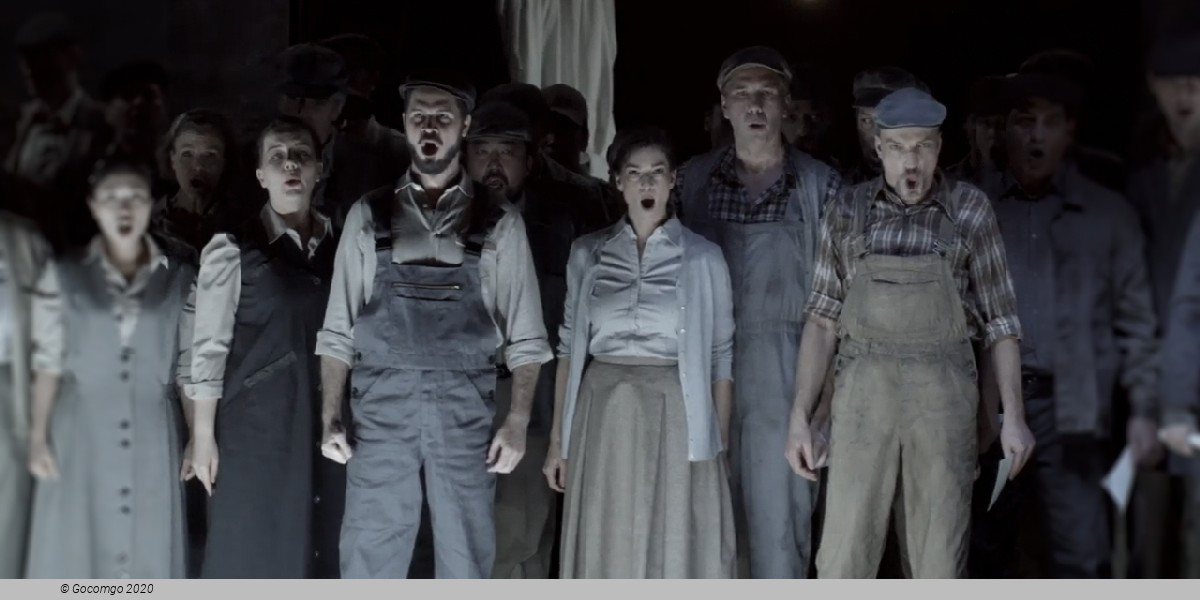
It is morning. The peasants and millers leave to work, the wings of the mills begin to turn (Prelude and pastoral chorus: La brise est muette).Berthe, a young peasant girl, is very happy to be able to marry the man she loves (Aria: Mon cœur s'élance et palpite). She welcomes her future mother-in-law, Fidès, who blesses her and puts an engagement ring on her finger. Berthe explains to Fidès that she needs the Count's permission to marry Jean whom she has loved ever since he rescued her from the Meuse. Before leaving for Leiden, where Fidès runs an inn with her son, Berthe must obtain permission from Oberthal to leave the country and to marry. The two women head for the count's castle, but stop at the sight of three men dressed in black. These are three Anabaptists, Jonas, Matthisen and Zacharie, singing their chorale, Ad nos ad salutarem (to a tune created by Meyerbeer). The Anabaptists arouse the interest of the local peasants in their ideas of social revolution and urge them to revolt against their overlord. The peasants arm themselves with pitchforks and sticks and make for the castle, but all stop at the sight of the Count of Oberthal and his soldiers. Seeing Berthe, Oberthal asks the girl about the reasons for her presence. Berthe explains that she has loved Fidès' son Jean since he saved her from drowning and asks his permission to marry. Oberthal however recognizes one of the Anabaptists, Jonas, as a former steward and orders soldiers to beat the three men. Taken by Berthe's beauty, he refuses her request and arrests the two women. The people become angry, and with the returning Anabaptists, threaten the castle.
Act 2
The interior of the inn of Jean and Fidès in the suburbs of Leiden in Holland. At the back, a door with crosses overlooking the countryside. Doors to the right and left of the stage
The Anabaptists enter with merrymaking peasants and try to persuade Jean that he is their destined leader, claiming that he closely resembles the picture of King David in Münster Cathedral. Jean recounts to them a dream in which he was in a temple with people kneeling before him. Jean tells the three Anabaptists that he lives only for his love for Berthe and refuses to join with them (Aria: Pour Berthe, moi je soupire); they leave. Berthe hurries in, having fled Oberthal; the Count next arrives and threatens to execute Jean's mother Fidès unless Berthe is returned to him. In despair, Jean gives in and hands over Berthe to Oberthal. Fidès blesses her son and attempts to console him (Aria: Ah ! mon fils sois béni). When the Anabaptists return, Jean is ready to join them in vengeance against Oberthal; he goes, without letting Fidès know (Quartet: Oui, c'est Dieu qui t'appelle).
Act 3
Scene 1
The camp of the Anabaptists in a forest of Westphalia. A frozen pond extends to the horizon lost in the mist and is bordered to the left and right of the scene by the forest. On the banks of the pond are erected the tents of the Anabaptists
Jean has been proclaimed to be a prophet. Anabaptist soldiers bring in a group of prisoners made up of richly clothed nobles and monks, whom they are threatening with axes. All the captives were going to be massacred, but Mathisen intervened and reminded the other Anabaptists that it would be better to execute them only once their ransom had been demanded and paid. Farmers arrive, skating across the frozen pond, bringing food which has been paid for with money stolen from the captives. The farmers are invited by the Anabaptist soldiers to celebrate with them (Ballet and chorus).
Scene 2
The interior of the tent of Zacharie, a few moments later
The Anabaptists determine to seize Münster; their decision is overheard by Oberthal who has entered the camp in disguise. He pretends that he wants to join the Anabaptists and Zacharie and Jonas then make him swear to respect the peasants and the poor, but to mercilessly massacre the nobles and the burghers, after having stripped them of their wealth. (Comic trio: Sous votre bannière que faudra-t-il faire ?) On his detection he is arrested; but when he informs Jean that Berthe escaped from his clutches,and he has seen her alive in Münster, Jean, wearying of the violence and bloodshed caused by the Anabaptist campaign, cancels the order for his execution.
Scene 3
The Anabaptists' camp
An attack on Münster led by the three Anabaptists fails, and the returning rabble are rebellious. However, Jean, as Prophet and Leader, inspires the Anabaptist troops with a celestial vision of their impending success (Triumphal hymn: Roi du ciel et des anges).
Act 4
Scene 1
The town hall of Münster, where several streets end. To the right, a few steps leading to the door of the town hall
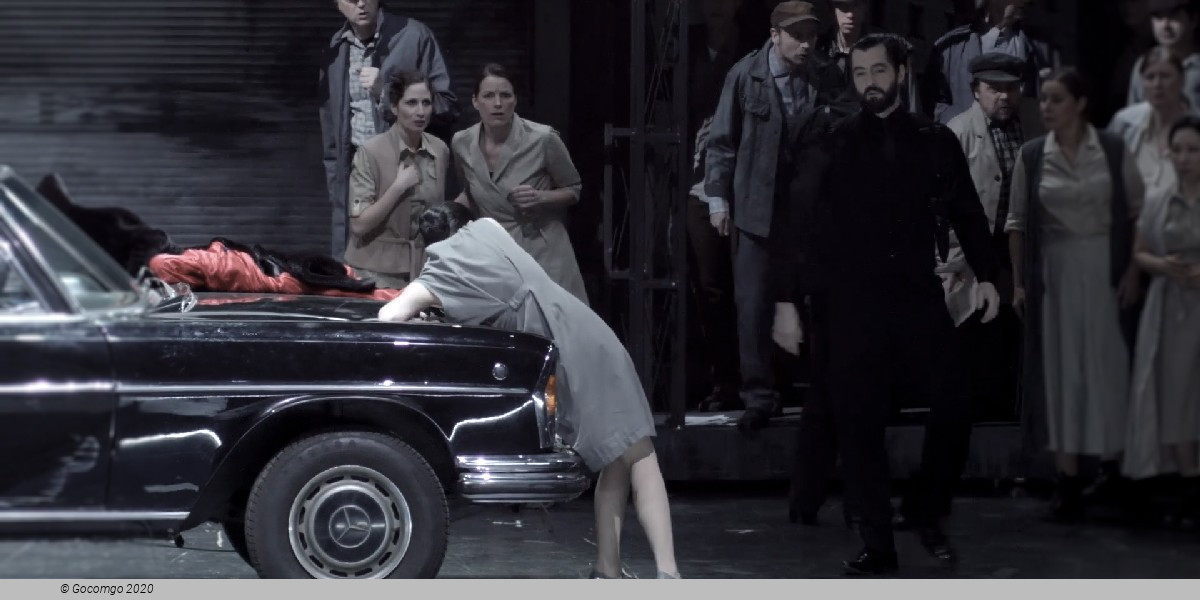
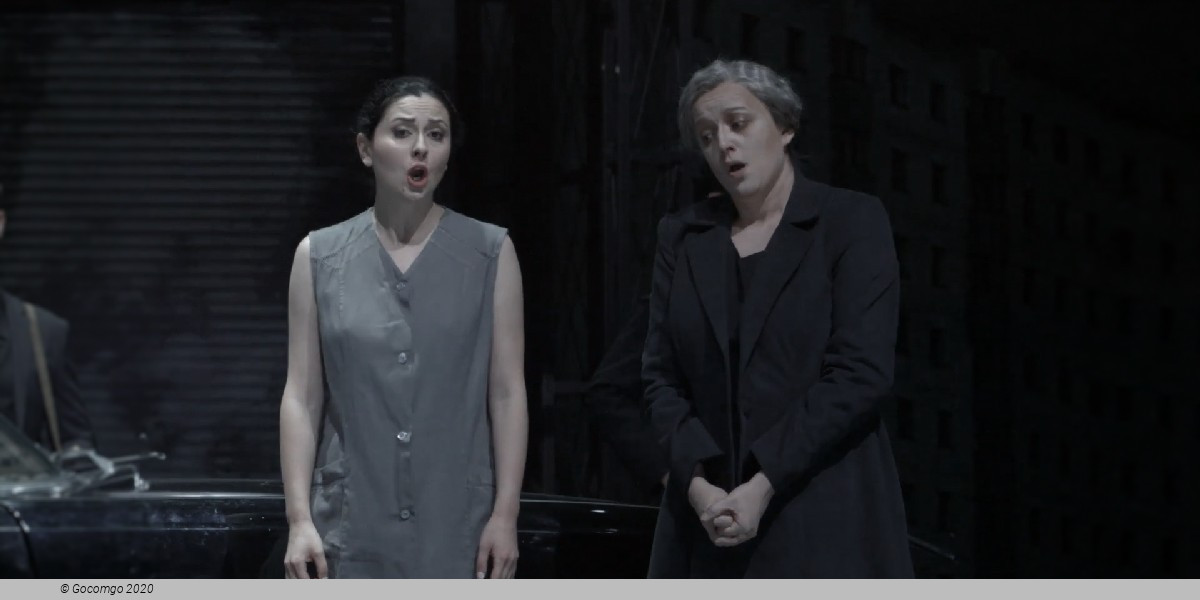
Jean, who wishes to make himself Emperor, has taken the city, whose citizens are in despair at his rule. Fidès sits on a pillar and begs for alms to pay for a Mass for the rest of her son, whom she thinks dead. Berthe, dressed in pilgrim's clothes, arrives in the square. She recognizes Fidès and the two women fall into each other's arms. Berthe relates that after she managed to escape from the Count of Oberthal, she sought Jean and her mother in their inn in Leiden. Neighbors told her they would have gone to Münster. Berthe immediately set out to try to find them. Fidès then tells the girl that her son died: she found only his bloodied clothes while an unknown person claimed to have witnessed his assassination ordered by the prophet of the Anabaptists. Berthe then decides to assassinate the prophet, while Fidès prays God to bring her son eternal rest. Exalted, the girl runs to the palace of the prophet while Fidès tries in vain to catch up (Duet: Pour garder à ton fils le serment).
Scene 2
Inside Münster Cathedral
The second scene is Jean's coronation in the cathedral and is preceded by a Coronation March, during which the crown, the scepter, the sword of justice, and the seal of the State, are handed over to Jean . Fidès is determined to carry out Berthe's plan for revenge; entering the cathedral, she curses the Anabaptists' prophet (Prayer and imprecation: Domine salvum fac regem). The coronation ends while the crowd marvels at the miracles already accomplished by the prophet and acclaim him as the Son of God, not conceived by woman (Children's chorus with general chorus: Le voilà, le roi prophète). When Fidès hears Jean say that he is anointed by God, she recognizes his voice and cries out "My son!". This threatens Jean's plan and he pretends not to know her. He calls on his followers to stab him if the beggar woman claims again to be his mother. This forces Fidès to retract, saying her eyes have deceived her.
Act 5
Scene 1
A vault in Jean's palace in Münster: on the left, a staircase through which one descends into the vault. To the right, an iron gate opening onto a tunnel that leads out of the city
The Anabaptist trio resolve to hand over Jean to the German Imperial armies, which are preparing to invade the city, to buy their own protection. Soldiers bring Fidès to the vault where she is held prisoner. She is torn apart by contradictory feelings: she still loves her son, but she loathes what he has become, a false prophet who pretends to be the son of God and who leads armies responsible for many crimes. Finally, Fidès seems ready to forgive the faults of her son, while wishing that death should come to free her from all her ills (Aria: Ô prêtres de Baal). A soldier announces to Fidès the visit of the prophet. She then regains a little hope and prays for her son to repent and take the right way. Jean finally arrives and asks his mother to forgive him. Fidès reproaches her son for his behavior. Jean tries to justify himself by recalling that he wished to avenge himself for the oppressions of the earl of Oberthal. The only way for Jean to obtain pardon from his mother is to give up his power and wealth and no longer claim to be a prophet. At first reluctant to abandon all those who trusted him, Jean is gradually convinced. He agrees to follow his mother who forgives all his faults (Grand duet: Mon fils ? je n'en ai plus !) Informed by a member of her family about the existence of secret passages, Berthe enters the vault in order to access the powder magazine and blow up the palace and all its inhabitants. As soon as she sees Jean, she throws herself into his arms and is about to flee with him and Fidès, abandoning her avenging mission. Jean, Berthe and Fidès, finally united, dream of their future life, peaceful and full of bliss. (Trio: Loin de la ville). A soldier, however, enters and warns Jean that the Imperial troops, assisted by the three Anabaptists, have invaded the city and entered the palace. Berthe realizes suddenly that Jean and the prophet are one and the same person. Shocked, she curses her fiancé and then stabs herself to death. Having lost forever the one he loved, Jean decides to die as well and to drag all his enemies to death.
Scene 2
The great hall of the Münster palace. A table placed on a platform rises in the middle of the stage
The Anabaptist soldiers feast and sing of the glory of their prophet at the banquet to celebrate his coronation. Young girls dance for them while others bring them wine and food (Bacchanale (Choral dance: Gloire, gloire au prophète) The three Anabaptists are watching Jean hoping that he will be drunk enough to be easily captured. Jean, on his part, warns his soldiers that they must be ready to close all the doors of the palace as soon as they receive his order. Jean encourages all to get drunk and asks the three Anabaptists to stand by his side as a reward for their fidelity (Drinking song: Versez, que tout respire l'ivresse). Suddenly, Oberthal at the head of imperial soldiers appears in the hall. He demands that the false prophet be executed without delay, a request which the three Anabaptists eagerly approve. In the confusion, nobody realizes that the doors of the palace have all been closed. A huge explosion then occurs and the flames grow from all sides. A wall collapses, allowing Fidès to join her son. Jean and his mother throw themselves into each other's arms for a last farewell, while all try in vain to escape from the conflagration that spreads more and more. The palace collapses in smoke and flames, killing all within (Final duet with chorus: Ah ! viens, divine flamme).








 Bismarckstraße 35