Act 1
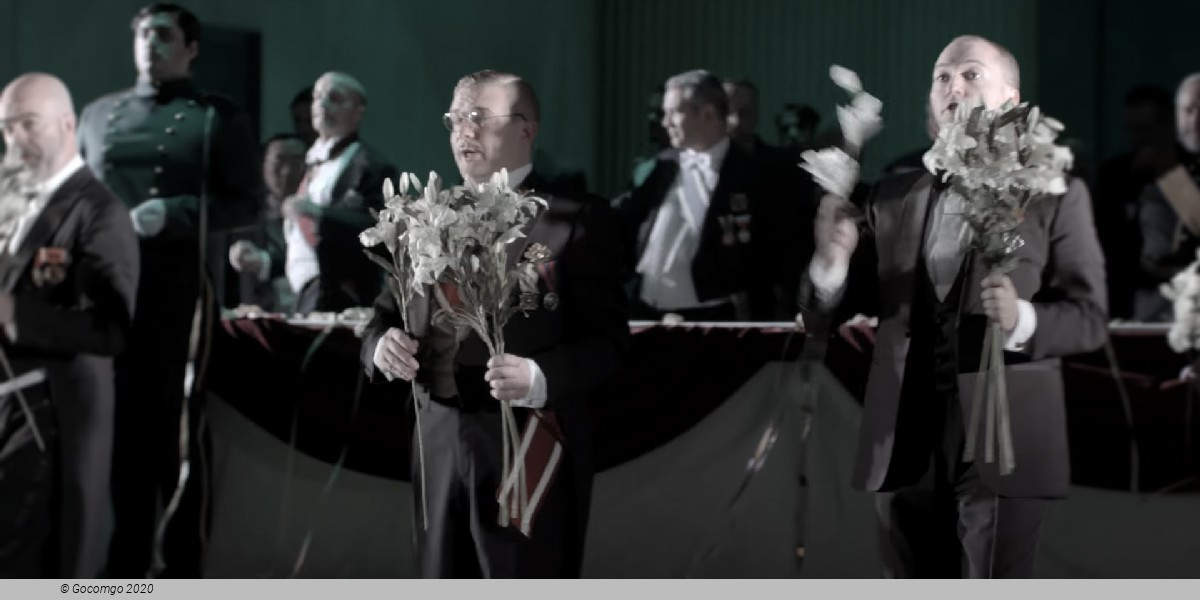
The stage represents the chateau of the Count of Nevers, in Touraine. In the background, large open windows show gardens and a lawn, on which several lords play ball; on the right, a door leading into the inner apartments; at left, a window closed by a curtain and which is supposed to lead to a prayer room; at the front of the stage, other lords are playing dice, cup and ball,etc. Nevers, Tavannes, Cossé, Retz, Thoré, Méru and other Catholic lords look at them and talk to each other.
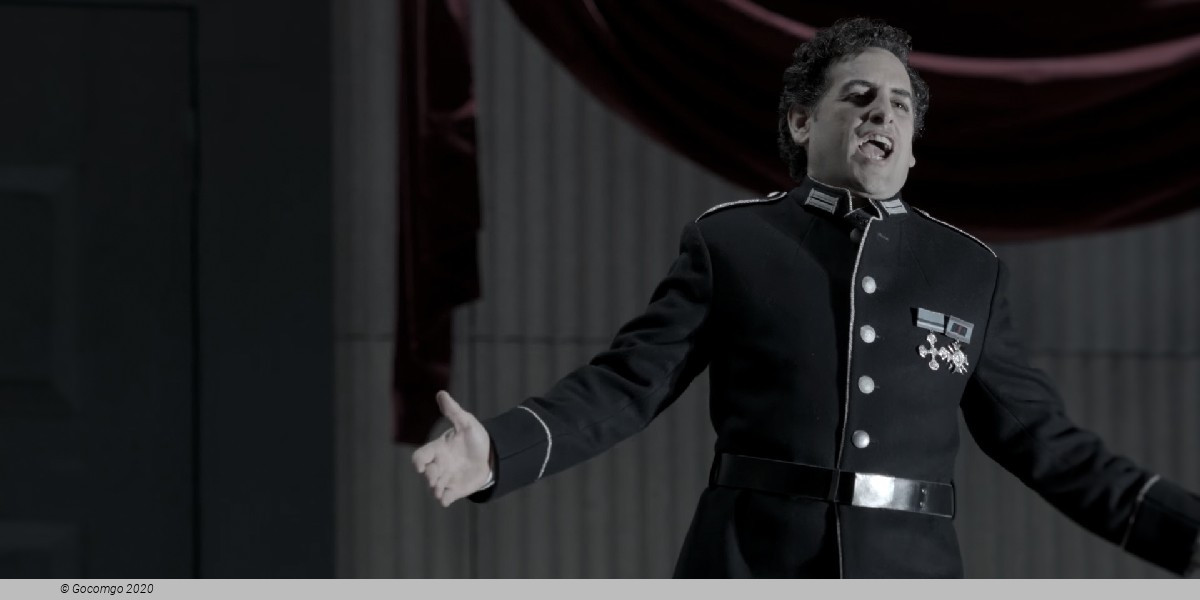
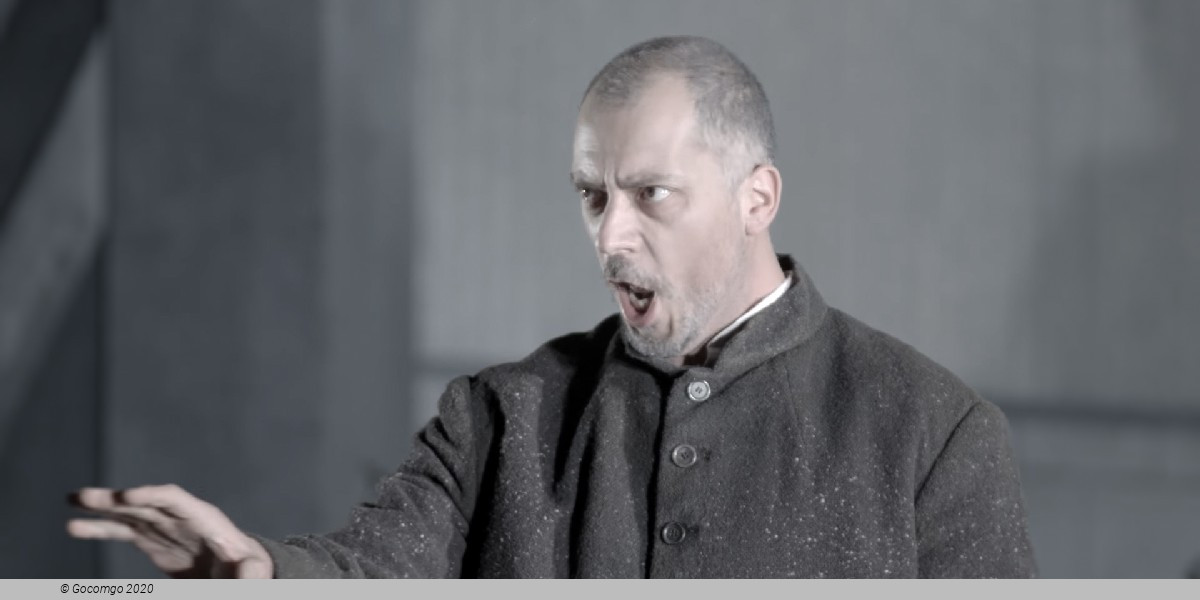
The Catholic Count of Nevers is entertaining his fellow noblemen. Their host informs them that before they can go to dinner, they must await the arrival of Raoul, a young Huguenot sent to them from the King in an effort to reconcile Protestant and Catholic. Raoul enters, very impressed with the surroundings and to be in the company of the noblemen. Lavish dishes of food and copious supplies of wine are brought in and the nobles encourage Raoul to drink ( L’orgie: "Bonheur de la table"). The Count of Nevers announces that he has just become engaged and that he must now give up his mistresses. However, he invites his guests to describe the ones they are in love with and asks the latest arrival, Raoul de Nangis. Raoul then tells how he rescued a girl from an attack on her in the street. Although he does not know her name or her origins, he immediately fell in love (Romance: "Plus blanche que la blanche hermine"). (With a daring and unusual stroke of orchestration, Meyerbeer accompanies this aria with a solo viola d'amore). Raoul's Protestant servant Marcel enters and the old man is shocked to see his master in such wicked company enjoying games, drinking and tales of love. Marcel sings a hearty Protestant prayer (to the tune of 'Ein feste Burg') while the Catholic lords toast their mistresses. One of the Catholics recognises the old man from a battle they fought and asks him to have a drink with him to bury any grudge. Marcel refuses, and then, at the Catholics' request,he sings a Huguenot battle song from the siege of La Rochelle, calling for the extermination of Catholics (Chanson huguenote: "Piff, paff, piff, paff"). The Catholics are merely amused by this.
A valet of the Count of Nevers informs his master that a mysterious woman wishes to speak to him. The count goes out to meet the stranger. Catholic lords wonder about the identity of the unknown woman and try to see her. They invite Raoul to do the same. Recognizing the young woman he saved and fell in love with, the young Huguenot, believing she is one of the mistresses of the Count of Nevers he has been boasting about, swears never to see her again. In fact she is Nevers' intended bride, Valentine (daughter of St. Bris), instructed by the Queen to break off her engagement. The page Urbain enters with a secret message for Raoul, daring him to come blindfolded to a secret rendezvous with an unnamed woman ( Cavatina: "Une dame noble et sage"). The Catholics recognize the seal on the letter as belonging to the Queen of Navarre and drink to Raoul's health as he is led away.
Act 2
The castle and gardens at the Château de Chenonceaux. The river meanders to the middle of the stage, disappearing from time to time behind clumps of green trees. On the right, a wide staircase by which we descend from the castle into the gardens.
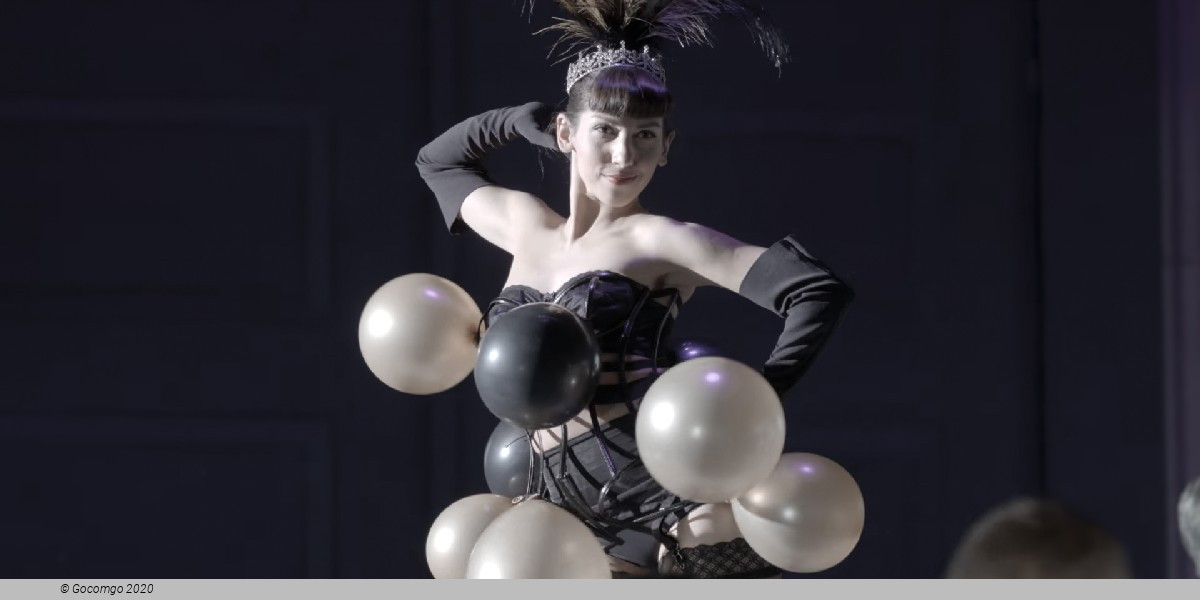
Queen Marguerite looks into a mirror held by her enamoured page Urbain, and sings a virtuoso pastorale (O beau pays de la Touraine). She hopes to avoid the religious strife plaguing France by remaining in the beautiful countryside (Cabaletta: A ce mot seul s’anime et renaît la nature).Valentine enters and reports that Nevers has agreed to break the engagement, which delights Marguerite as, knowing that Valentine has fallen in love with Raoul de Nangis, she is sure that she will be able to persuade Valentine's father, the Catholic Saint-Bris, to allow his daughter to marry the young Protestant as a step towards ending sectarian strife. Marguerite's entourage of ladies enter dressed for bathing. This leads to a ballet during which the page Urbain attempts to spy on the scantily clad ladies as they frolic in the water. Urbain laughingly describes the journey of Raoul, blindfolded, to the castle (Rondeau: "Non, non, non, vous n’avez jamais, je gage") He enters and the Queen tells her ladies to leave him alone with her. With his sight restored,Raoul is amazed by the beauty of his surroundings as well as that of the young woman who stands before him, while she is tempted to try to keep the charming young man for herself rather than have him marry Valentine as she had planned (Duet: "Beauté divine enchanteresse").The lords and ladies of the court, including Nevers and Saint-Bris enter, and the Queen orders everyone to swear friendship and peace, which all aver, except for Marcel, who disapproves of his master mixing with Catholics (Oath:Par l’honneur, par le nom que portaient). The Queen presents Valentine to Raoul as the girl he loves and will marry to cement relations between the Protestant and Catholic factions. In a complex final ensemble, Raoul, who believes Valentine is the mistress of Nevers, refuses to comply with the Queen's command. The nobles then swear revenge, Valentine is devastated by this insult to her honour, the Queen does not understand Raoul's reason for rejecting the marriage and Marcel reproaches Raoul for consorting with Catholics.
Act 3
Paris, the 'Pré aux clercs' on the left bank of the Seine, at sunset. On the left, a tavern where Catholic students sit with girls; on the right, another tavern in front of which Huguenot soldiers drink and play dice. In the background, on the left, the entrance to a chapel. In the middle, a huge tree shading the meadow. At the front of the stage, clerics from La Basoche and grisettes sit on chairs and chat between themselves. Others are walking around. Workers, merchants,traveling musicians, monks, and middle-class townspeople. It is six o'clock in the evening, in the month of August.
Citizens enjoy a stroll on a beautiful Sunday evening (Entracte et chœur: C’est le jour de dimanche). The Huguenot soldiers sing a blood-thirsty war song in praise of the Protestant Admiral Coligny (Couplets militaires: "Prenant son sabre de bataille"). A procession of Catholic girls crosses the scene on the way to the chapel where Valentine and Nevers are about to be married, chanting praise to the Virgin (Litanies :" Vierge Marie, soyez bénie !") Marcel enters with a letter from Raoul to Saint-Bris and interrupts the procession, seeking to know Saint-Bris's whereabouts. The Catholics are outraged by Marcel's sacrilege but the Huguenot soldiers defend him. Tension is rising when a band of gypsies enter, dancing and telling fortunes, and calm things down (Ronde bohémienne: "Venez ! – Vous qui voulez savoir d’avance" and gypsy dance). Valentine has just married Nevers, but remains in the chapel to pray. Marcel delivers a challenge from Raoul. Saint-Bris decides to kill Raoul, but is overheard by Valentine. The town crier declares curfew (the scene anticipating a similar one in Wagner's Die Meistersinger) and the crowds disperse. Valentine, in disguise, tells Marcel of the plot by her father and others to murder Raoul (Duet:Dans la nuit où seul je veille). Valentine realises that despite the public humiliation inflicted on her by Raoul she still loves him and returns to the chapel. Raoul, Saint-Bris and their witnesses arrive for the duel, each confident of success (Septet: "En mon bon droit j’ai confiance"). Marcel calls for assistance from the Huguenot soldiers in the tavern on the right and Saint-Bris to the Catholic students in the tavern on the left and a near-riot ensues. Only the arrival of the Queen, on horseback, stems the chaos. Raoul realises that Valentine has saved him and that his suspicions of her were unfounded. However, now she is married to his enemy and indeed at that moment an illuminated barge appears on the river with wedding guests serenading the newly wedded couple (Wedding chorus:"Au banquet où le ciel leur apprête"). Nevers leads her away in a splendid procession as Catholics and Protestants loudly proclaim their murderous hatred of each other (Chorus of fighters:"Non, plus de paix ni trêve").
Act 4
A room in Nevers' Parisian town-house. Family portraits decorate the walls. In the background, a large door and a large Gothic cross. On the left, a door that leads to Valentine's bedroom. On the right, a big chimney, and near the chimney the entrance to a room closed by a tapestry. On the right, and in the foreground, a window overlooking the street.
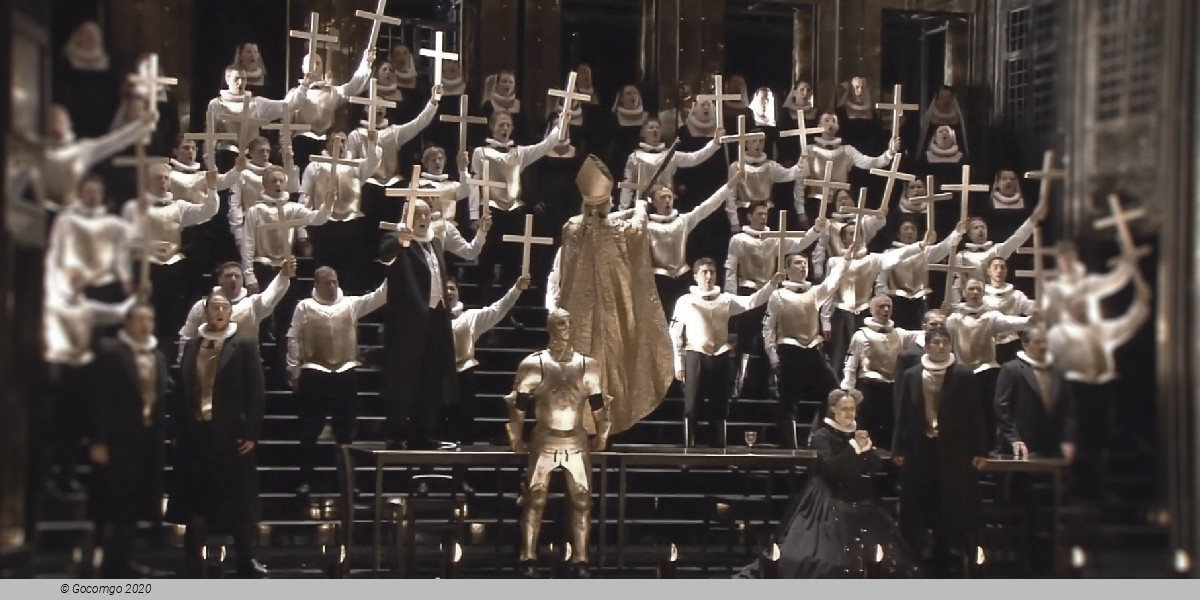
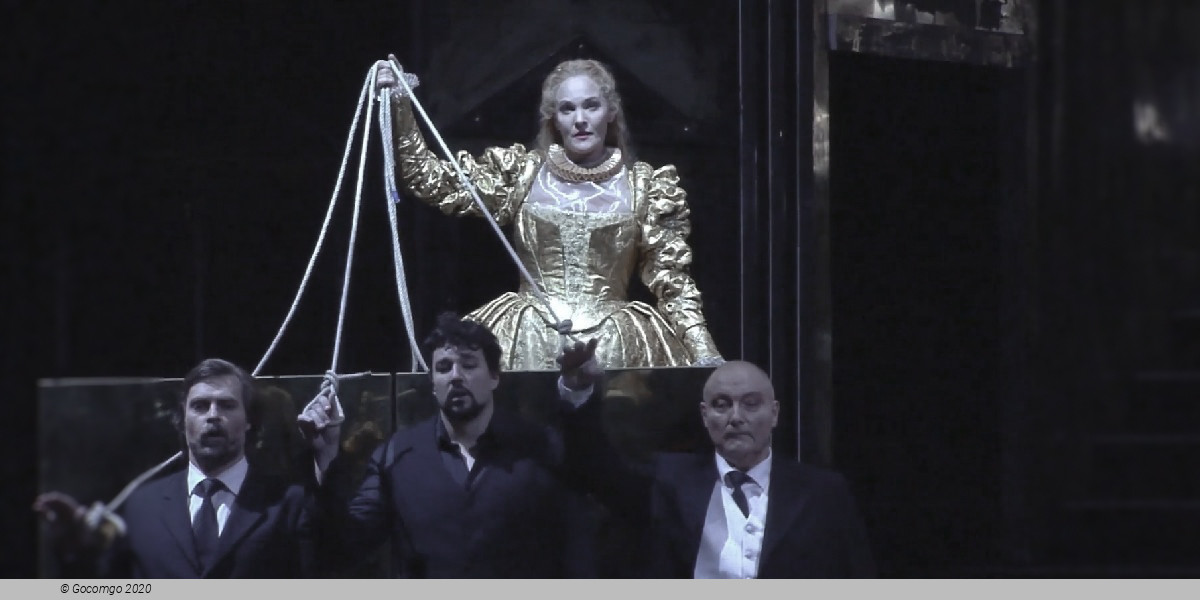
Valentine, alone, expresses her sorrow at being married to Nevers when she is really in love with Raoul (Air: "Parmi les pleurs mon rêve se ranime"). She is surprised by Raoul who wishes to have one last meeting with her. The sound of approaching people leads Raoul to hide behind a curtain, where he hears the Catholic nobles pledge to murder the Huguenots. They are accompanied by three monks, who bless the swords and daggers to be used in the massacre, declaring it to be God's will that the heretics be killed. Only Nevers does not join in the oath (Conjuration:"Des troubles renaissants"). This scene is generally judged the most gripping in the opera, and is accompanied by some of its most dramatic music. When the nobles have departed, Raoul re-appears and is torn between warning his fellows and staying with Valentine (Duet:"Ô ciel! où courez-vous ?"). Valentine is desperate to prevent him from meeting death by going to the assistance of his fellow Protestants and admits she loves him, which sends Raoul into raptures. However they hear the bell of Saint-Germain-l'Auxerrois ringing, the signal for the massacre to begin,and Valentine faints as Raoul leaps out the window to join his co-religionists.
Act 5
Scene 1: A beautifully lit ballroom in the Hôtel de Nesle
The Protestants are celebrating the marriage of the Queen to Henry of Navarre. The tolling of a bell interrupts the dancing and festivities, as does the entrance of Raoul, in torn clothing covered in blood, who informs the assembly that the second stroke was the signal for the Catholic massacre of the Huguenots. Admiral Coligny has been assassinated, Raoul tells them, and Protestant men, women and children are being slaughtered in the street by the thousands. The women flee, panic-stricken, as the Protestant men prepare to defend themselves.
Scene 2: A cemetery: in the background, a Protestant church whose stained glass windows are visible. On the left, a small door that leads into the interior of the church. On the right, a gate that overlooks a crossroads
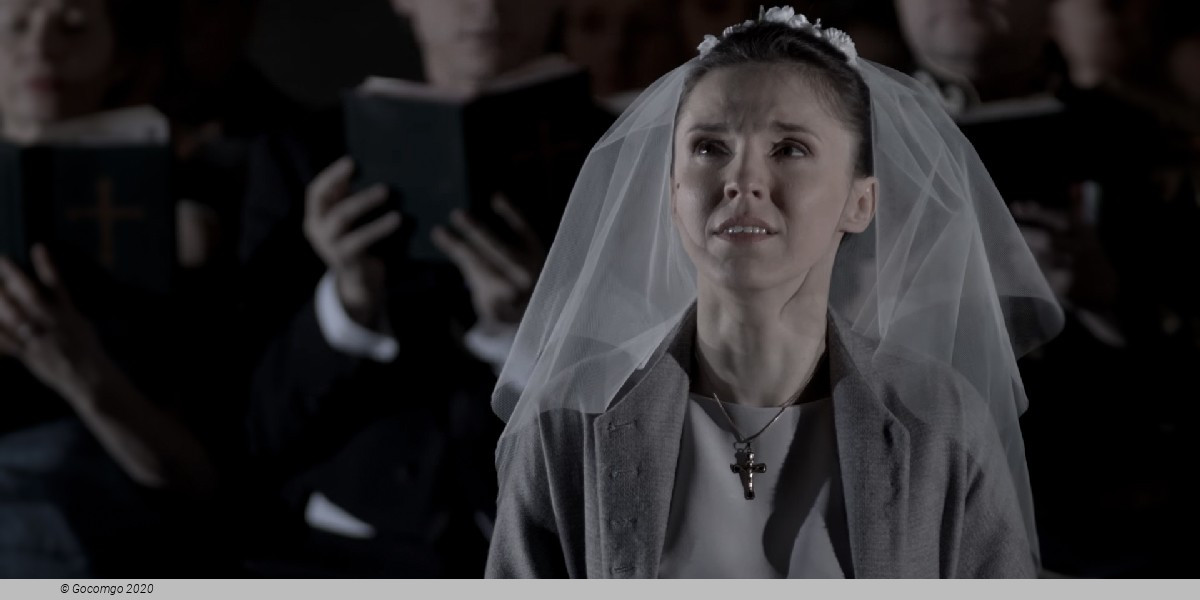
Under the leadership of Marcel, Protestant women take refuge with their children in the church. It is there that Raoul finds his old servant, who, resigned, prepares to die. Valentine arrives and tells Raoul that his life will be saved if he agrees to wear a white scarf around his arm, indicating that he is Catholic. She also informs the young man that she is now free, Nevers having been killed after having defended Protestants. Raoul seems to hesitate but finally refuses Valentine's proposal to pass as Catholic. She immediately decides to share the fate of the one she loves by abjuring the Catholic faith. She asks Marcel to bless her. Marcel does so and declares the couple married in the sight of God (Trio: "Savez-vous qu’en joignant vos mains"). Meanwhile, the Protestants who barricaded themselves in the church intone Luther's hymn "Ein feste Burg". Suddenly, the singing inside the church is interrupted. The Catholics have broken down the door of the church and threaten to kill all the Protestant women and children if they do not renounce their faith. After refusing, the Protestants resume their singing, interrupted several times by musket shots. Finally, the song is no longer heard: all were massacred. At the height of exaltation, Marcel thinks he hears the march of angels leading the martyrs to God. Valentine and Raoul share this vision of heaven 'with six harps'. (Trio:"Ah ! voyez ! Le ciel s’ouvre et rayonne !"). Catholic soldiers enter the cemetery, seize Raoul, Valentine and Marcel and drag them away,wounding all three, after they refuse to abjure their faith.
Scene 3: A street in Paris, on the night of August 23 to 24, 1572
Wounded, they are finally murdered by St. Bris and his men, he realising only too late that he has killed his own daughter. (Cf. the closing scene of Fromental Halévy's opera, La Juive, libretto also by Scribe, produced a year earlier than Les Huguenots). It is at this moment that Marguerite's litter appears. She also recognizes Valentine and tries to stop the massacre, to no avail. A chorus of soldiers,hunting for more Protestants to murder and singing 'God wants blood!', brings the opera to a close.


 Bismarckstraße 35