

Deutsche Oper Berlin 4 June 2022 - The Treasure Hunter | GoComGo.com

The Treasure Hunter

Deutsche Oper Berlin, Main Stage, Berlin, Germany
All photos (1)
Select date and time
7:30 PM

E-tickets: Print at home or at the box office of the event if so specified. You will find more information in your booking confirmation email.

You can only select the category, and not the exact seats.
If you order 2 or 3 tickets: your seats will be next to each other.
If you order 4 or more tickets: your seats will be next to each other, or, if this is not possible, we will provide a combination of groups of seats (at least in pairs, for example 2+2 or 2+3).

Important Info
Type: Opera
City: Berlin, Germany
Starts at: 19:30
Acts: 4
Intervals: 1
Duration: 2h 45min
Sung in: German
Titles in: German,English

E-tickets: Print at home or at the box office of the event if so specified. You will find more information in your booking confirmation email.

You can only select the category, and not the exact seats.
If you order 2 or 3 tickets: your seats will be next to each other.
If you order 4 or more tickets: your seats will be next to each other, or, if this is not possible, we will provide a combination of groups of seats (at least in pairs, for example 2+2 or 2+3).

Overview

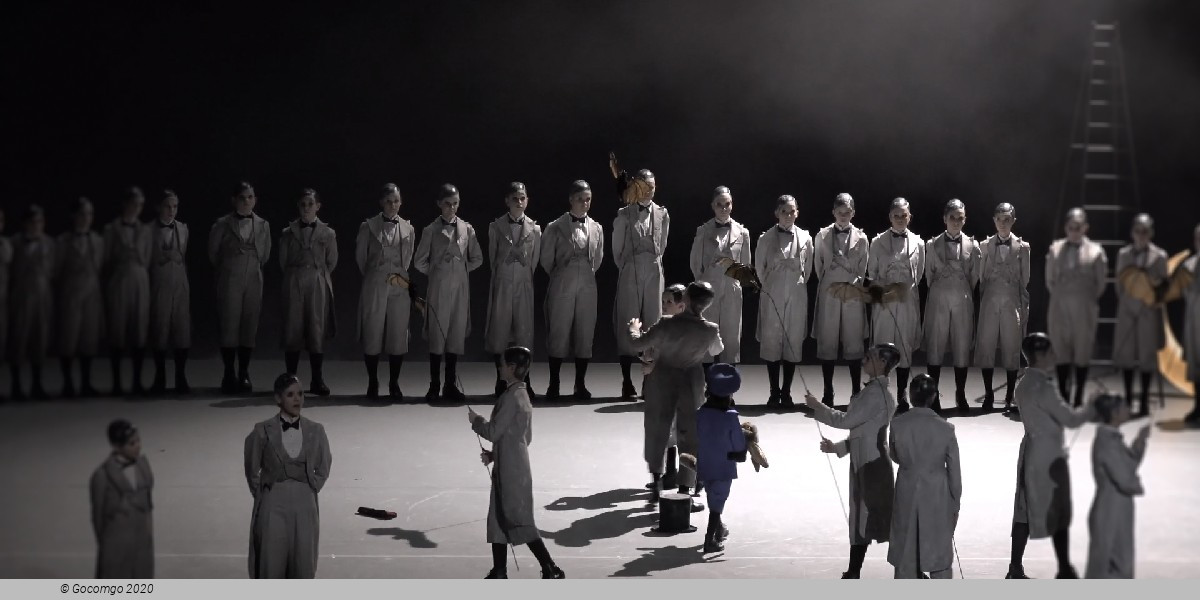
At the Deutsche Oper Berlin, Christof Loy already has a reputation as a comeback agent for little-known early-20th-century operas, having staged successful productions of Erich Wolfgang Korngold’s THE MIRACLE OF HELIANE and Riccardo Zandonai’s FRANCESCA DA RIMINI. He now tackles another long-forgotten work: Franz Schreker’s THE TREASURE HUNTER, one of the most important operas of the 20th century. The work was a triumph at its world premiere in Frankfurt in 1920 and went on to play 44 times at assorted venues over the next five years. It then fell victim to a shifting zeitgeist and slipped from opera-house programs, with a National Socialist ban on performances sealing its demise. Even after 1945, the Schreker revival was a long time coming – and THE TREASURE HUNTER has not featured prominently in the renaissance.

As with the vast majority of Schreker’s libretti, the story of Els and Elis explores the relationship between fantasy and reality, between art and life. Soulmates in the sense that they are both at the mercy of the king’s disposition, Els and Elis set off in search of different treasures. Elis, the minstrel, uses his magic lute to locate a stash of jewels and do humanity a good turn. Els, an innkeeper’s daughter who has grown up motherless in a tough, male-chauvinist world, becomes a liar, cheat, and murderess in pursuit of her goal, tasking her suitors to steal the queen’s jewels and then having them killed once they have returned with the haul of treasure. Yet even with the gold in their possession, the pair are not content, and so, true to form, Schreker turns his attention to the theme of yearning per se, which is the actual “treasure” that the composer is interested in, “a dream of happiness and redemption”. Elis and Els are caught up in a swirl of dreams, memories, premonitions, songs, and music. Their stories take on a dreamlike quality in a world beset by greed, murder, and emotional inconstancy. For Franz Schreker the path to redemption could only be via art. Composed during the turmoil of the First World War, the TREASURE HUNTER score amounts to Schreker’s personal confession of artistic faith, executed in florid strokes of late-Romantic musical color.

Christof Loy is one of the most sought-after directors in the landscape of international opera and theatre. This is his sixth collaboration with the Deutsche Oper Berlin. He staged FALSTAFF here and also the world’s first-ever production of Andrea Lorenzo Scartazzini’s EDWARD II. His directorial work on Janáček’s JENŮFA in 2012, which was captured on DVD, earned him 2nd prize in the “Best Opera Recording” category at the Grammy Awards. With THE TREASURE HUNTER at the Deutsche Oper Berlin, Christof Loy continues his exploration of strong female characters in little-known 20th-century works. In 2018 “Opernwelt” magazine voted his production of Erich Wolfgang Korngold’s THE MIRACLE OF HELIANE, conducted by Marc Albrecht, the “Rediscovery of the Year” and awarded it an OPUS KLASSIK as best DVD recording, in partnership with the Naxos label. In March 2021 Riccardo Zandonai’s FRANCESCA DA RIMINI had its online premiere at the Bismarckstrasse venue.

Collaborations between Marc Albrecht and the Deutsche Oper Berlin have a long tradition. Following spectacular productions such as Messiaen’s SAINT FRANÇOIS D‘ASSISE and Janáček’s THE MAKROPULOS AFFAIR, he has now resumed his work at the Deutsche Oper, firstly with THE MIRACLE OF HELIANE and now with THE TREASURE HUNTER. Marc Albrecht’s time as Principal Guest Conductor at the Deutsche Oper Berlin from 2001 to 2014 ushered in an international career that saw him working at opera houses in Milan, Zurich, Bayreuth, and Amsterdam. He has often collaborated with Christof Loy, with joint projects including THE BASSARIDS (2008, Munich), THE PRINCE OF HOMBURG (2009, Theater an der Wien), ARABELLA (2014), and TANNHÄUSER (2019, Amsterdam).

Elisabet Strid debuts at the Deutsche Oper Berlin with her rendition of Els. Since making her mark as Elisabeth (TANNHÄUSER) in Oslo the Swede has established herself as one of the new internationally active sopranos singing in the German language. Most recently she triumphed as Sieglinde at the Teatro Real Madrid, Royal Opera Stockholm, GotenburgsOperan, Rheinoper Düsseldorf-Duisburg, Norske Opera Oslo and Lyric Opera Chicago. Daniel Johansson returns to the Deutsche Oper Berlin as a minstrel and treasure hunter Elis. As one of the leading tenors of his generation, the Swede’s performances include Cavaradossi (TOSCA), Rodolfo (LA BOHEME), Pinkerton (MADAMA BUTTERFLY), Lohengrin, and Narraboth (SALOME).

History
Premiere of this production: 21 January 1920, Oper Frankfurt

Der Schatzgräber (The Treasure Hunter) is an opera in four acts, with a prologue and an epilogue, by Franz Schreker with a libretto by the composer.

Synopsis

The opera is set in legendary medieval times.

Prologue
The queen has lost her jewels and with them her beauty and fertility. The king seeks the advice of his fool who knows about Elis, a wandering minstrel whose magic lute has the ability to hunt down hidden treasure. The king promises the fool that he will be allowed to have a wife of his choice as a reward if Elis can find the jewels.

Act 1
Els, daughter of the innkeeper, has to marry a brutal but rich young nobleman she despises. She, therefore, sends him away to find the queen's jewels and has him murdered by Albi, her servant, who is in love with her. The minstrel Elis has meanwhile found his way to the inn and presents Els with an ornament he has found in the woods. Els falls in love with the young minstrel, but then the body of the dead nobleman is found in the woods; the bailiff, who wants Els for himself, arrests Elis on suspicion of murder.

Act 2
Elis is to be hanged for his crime. Els asks the fool for help, who assures her that all will turn out well. The king's messenger stops the execution at the last moment, so Elis can go in search of the jewels. To avoid being exposed as the thief, Els orders Albi to steal the minstrel's magic lute.

Act 3
During a night of love, Els presents herself to Elis in the full beauty of the jewels. She hands over the jewelry to him, on the condition that he will never ask her about their provenance, and will always trust her.

Act 4
Elis has returned the jewels to the queen. During a celebration, the bailiff intervenes and announces that Albi has confessed to the murder. Els is denounced as the instigator of the murder, and the bailiff demands her immediate execution. But the fool, reminding the king of his promise, chooses Els as his wife and thus saves her from being executed. They go off together.

Epilogue
It is one year later and Els is dying. Only the fool has remained with her. He fetches Elis, who sings his most beautiful ballad for Els about a fairy-tale palace where they will be welcomed as Prince and Princess. Consoled, she dies in the minstrel's arms. The Fool mourns her death.

Venue Info

Deutsche Oper Berlin - Berlin
Location   Bismarckstraße 35

Venue's Capacity: 1698

The Deutsche Oper Berlin is an opera company located in the Charlottenburg district of Berlin, Germany. The resident building is the country's second-largest opera house and also home to the Berlin State Ballet. Since 2004 the Deutsche Oper Berlin, like the Staatsoper Unter den Linden (Berlin State Opera), the Komische Oper Berlin, the Berlin State Ballet, and the Bühnenservice Berlin (Stage and Costume Design), has been a member of the Berlin Opera Foundation.

The company's history goes back to the Deutsches Opernhaus built by the then independent city of Charlottenburg—the "richest town of Prussia"—according to plans designed by Heinrich Seeling from 1911. It opened on November 7, 1912 with a performance of Beethoven's Fidelio, conducted by Ignatz Waghalter. In 1925, after the incorporation of Charlottenburg by the 1920 Greater Berlin Act, the name of the resident building was changed to Städtische Oper (Municipal Opera).

With the Nazi seizure of power in 1933, the opera was under control of the Reich Ministry of Public Enlightenment and Propaganda. Minister Joseph Goebbels had the name changed back to Deutsches Opernhaus, competing with the Berlin State Opera in Mitte controlled by his rival, the Prussian minister-president Hermann Göring. In 1935, the building was remodeled by Paul Baumgarten and the seating reduced from 2300 to 2098. Carl Ebert, the pre-World War II general manager, chose to emigrate from Germany rather than endorse the Nazi view of music, and went on to co-found the Glyndebourne opera festival in England. He was replaced by Max von Schillings, who acceded to enact works of "unalloyed German character". Several artists, like the conductor Fritz Stiedry and the singer Alexander Kipnis, followed Ebert into emigration. The opera house was destroyed by a RAF air raid on 23 November 1943. Performances continued at the Admiralspalast in Mitte until 1945. Ebert returned as general manager after the war.

After the war, in what was now West Berlin, the company, again called Städtische Oper, used the nearby Theater des Westens; its opening production was Fidelio, on 4 September 1945. Its home was finally rebuilt in 1961 but to a much-changed, sober design by Fritz Bornemann. The opening production of the newly named Deutsche Oper, on 24 September, was Mozart's Don Giovanni.

Past Generalmusikdirektoren (GMD, general music directors) have included Bruno Walter, Kurt Adler, Ferenc Fricsay, Lorin Maazel, Gerd Albrecht, Jesús López-Cobos, and Christian Thielemann. In October 2005, the Italian conductor Renato Palumbo was appointed GMD as of the 2006/2007 season. In October 2007, the Deutsche Oper announced the appointment of Donald Runnicles as their next Generalmusikdirektor, effective August 2009, for an initial contract of five years. Simultaneously, Palumbo and the Deutsche Oper mutually agreed to terminate his contract, effective November 2007.

On the evening of 2 June 1967, Benno Ohnesorg, a student taking part in the German student movement, was shot in the streets around the opera house. He had been protesting against the visit to Germany by the Shah of Iran, who was attending a performance of Mozart's The Magic Flute.

In 1986 the American Berlin Opera Foundation was founded.

In April 2001, the Italian conductor Giuseppe Sinopoli died at the podium while conducting Verdi's Aida, at age 54.

In September 2006, the Deutsche Oper's Intendantin (general manager) Kirsten Harms drew criticism after she cancelled the production of Mozart's opera Idomeneo by Hans Neuenfels, because of fears that a scene in it featuring the severed heads of Jesus, Buddha and Muhammad would offend Muslims, and that the opera house's security might come under threat if violent protests took place. Critics of the decision include German Ministers and the German Chancellor Angela Merkel. The reaction from Muslims has been mixed — the leader of Germany's Islamic Council welcomed the decision, whilst a leader of Germany's Turkish community, criticising the decision, said:

This is about art, not about politics ... We should not make art dependent on religion — then we are back in the Middle Ages.

At the end of October 2006, the opera house announced that performances of Mozart's opera Idomeneo would then proceed. Kirsten Harms, after announcing in 2009 that she would not renew her contract beyond 2011, was bid farewell in July of that year.

Important Info
Type: Opera
City: Berlin, Germany
Starts at: 19:30
Acts: 4
Intervals: 1
Duration: 2h 45min
Sung in: German
Titles in: German,English
Top of page