
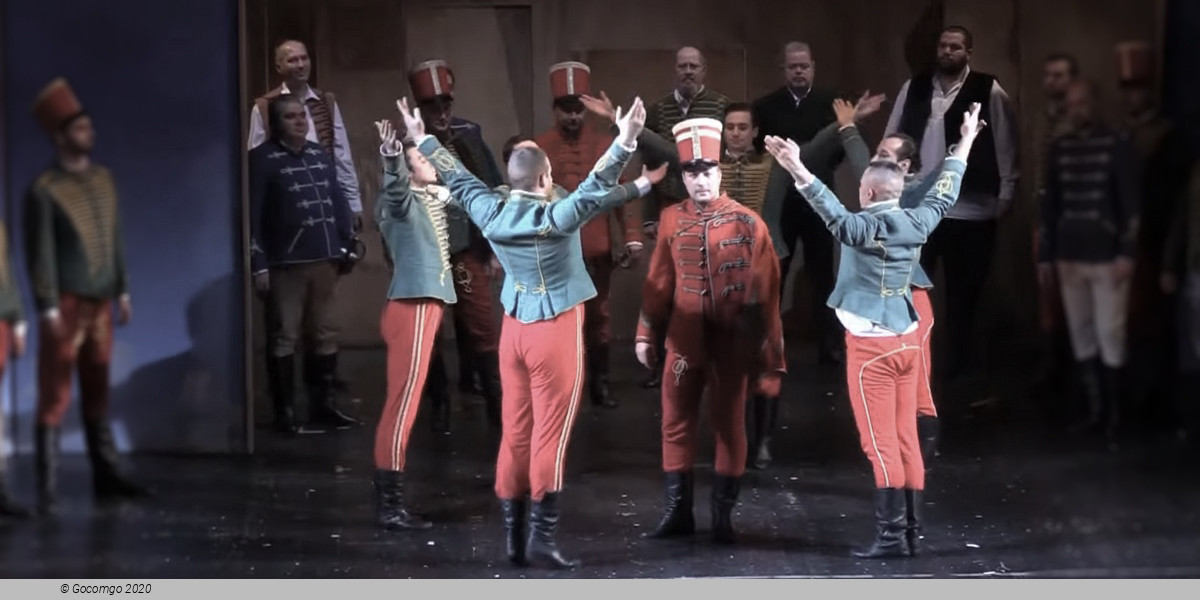
Hungarian State Opera House tickets 24 October 2026 - Háry János | GoComGo.com

Háry János

Hungarian State Opera House, Opera House, Budapest, Hungary
All photos (3)
Select date and time
6:30 PM
From
US$ 91

E-tickets: Print at home or at the box office of the event if so specified. You will find more information in your booking confirmation email.

You can only select the category, and not the exact seats.
If you order 2 or 3 tickets: your seats will be next to each other.
If you order 4 or more tickets: your seats will be next to each other, or, if this is not possible, we will provide a combination of groups of seats (at least in pairs, for example 2+2 or 2+3).

Important Info
Type: Opera
City: Budapest, Hungary
Starts at: 18:30
Acts: 4
Intervals: 1
Duration: 2h 45min
Sung in: Hungarian
Titles in: Hungarian,English

E-tickets: Print at home or at the box office of the event if so specified. You will find more information in your booking confirmation email.

You can only select the category, and not the exact seats.
If you order 2 or 3 tickets: your seats will be next to each other.
If you order 4 or more tickets: your seats will be next to each other, or, if this is not possible, we will provide a combination of groups of seats (at least in pairs, for example 2+2 or 2+3).

Cast
Performers
Conductor: Péter Halász
Bass-Baritone: Csaba Sándor (Háry János)
Mezzo-Soprano: Gabriella Balga (Örzse)
Choir: Hungarian State Opera Children`s Chorus
Soprano: Szilvia Rálik (Empress of Austria)
Mezzo-Soprano: Zsófia Kálnay (Marie Louise)
Creators
Composer: Zoltán Kodály
Director: Attila Béres
Librettist: Béla Paulini
Librettist: Zsolt Harsányi
Overview

This centenary staging invites audiences to rediscover the opera’s timeless beauty, cultural significance, and extraordinary ability to build a bridge between past and present through the universal language of music. At the conductor’s podium stands Péter Halász, the OPERA’s principal guest conductor and former music director.

A century ago, the world first encountered this remarkable opus, a work that soon became one of the cornerstones of twentieth-century musical innovation. Premiered in 1926, the singspiel is a milestone in Hungarian music history: its composer, Zoltán Kodály, fulfilled his aspiration to elevate Hungarian folk song of ancient origin to the same status as classical music, by virtue of its equivalent values, placing it on the stage of the nation’s Opera House. The Hungarian historical tale woven from folk songs blends elements of science fiction, the absurd, and at times painful historical reality, yet remains firmly grounded in love of homeland and pure love. The main roles of the hundred-year-old work are performed by two Hungarian artists from beyond our borders: Csaba Sándor from Transylvania and Gabriella Balga from Slovakia. It is staged by Transylvania-born Attila Béres, director of the Miskolc National Theatre, as his first production at the Opera House. His interpretation respects the spirit of the original while remaining open to the possibilities of the present.

History
Premiere of this production: 30 November 1925, Royal Hungarian Opera House, Budapest

Háry János is a Hungarian folk opera in four acts by Zoltán Kodály with a libretto by Béla Paulini and Zsolt Harsányi. The opera is in the Singspiel style. The libretto is based on János Garay's comic poem "The Veteran" (Az obsitos) about a drunkard named Háry János. The subtitle of the piece is Háry János Kalandozásai Nagyabonytul a Burgváráig – Háry János: his Adventures from Nagyabony (Great Abony) to the Vienna Burg.

Synopsis

Overture

Prologue – The Tale Begins

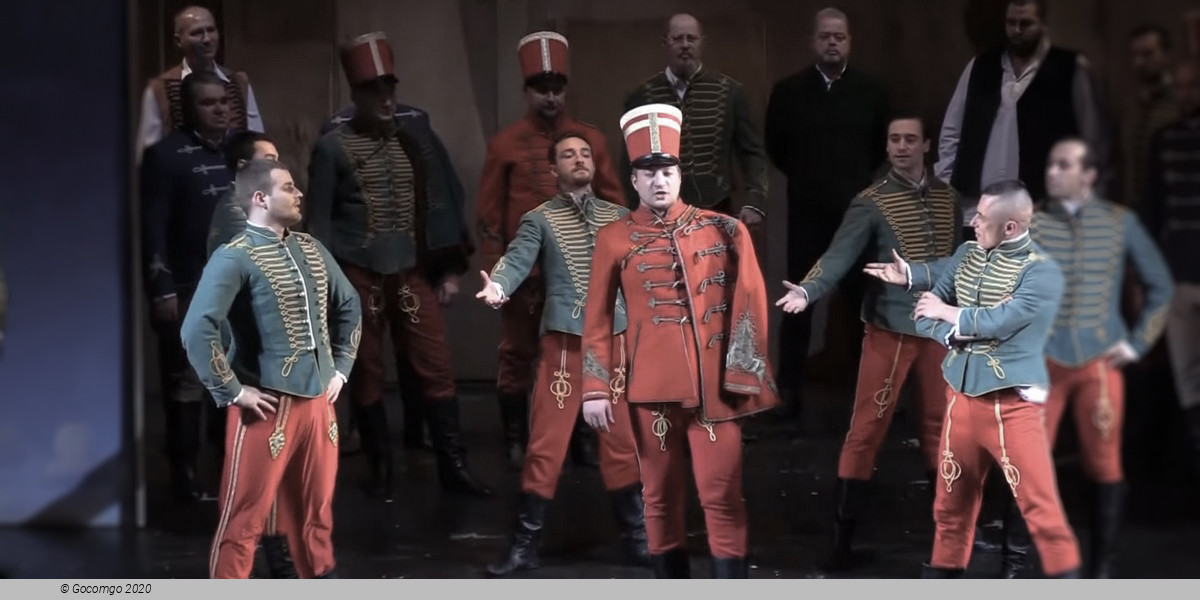
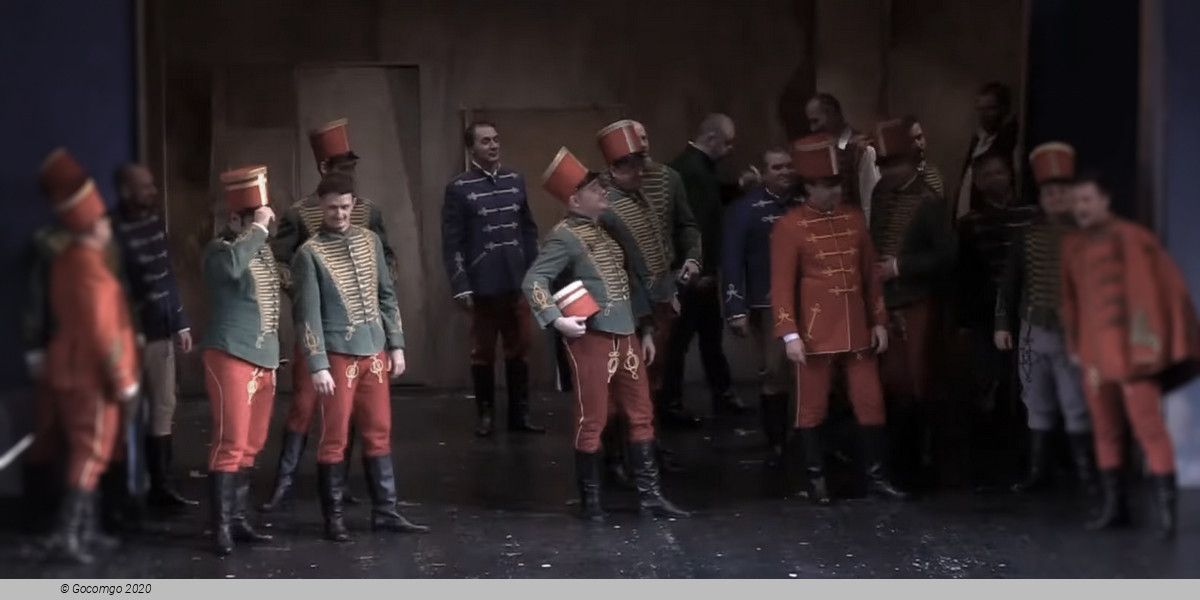
In the Hungarian village of Nagyabony people gather at the tavern. A picture of Napoleon hangs on the wall. The regulars and students wait glass in hand for the next tale from the old soldier Háry János.

First Adventure – On the frontier near Moscow.

A border crossing point between Galicia and Russia; there is frost and ice on the Russian side, sun shining and flowers blooming on the Hungarian side. János, after having got rid of all his female admirers meets Örzse.

The court chamberlain complains that Mária Lujza and her retinue have not been able to cross the frontier. Örzse and János talk with Marci, a Hungarian coachman working at the French Court, who tells them that Mária Lujza, the daughter of the Emperor, is being refused passage by the Russian guard. János pushes the border gate along the ground, so that she finds herself across the Hungarian frontier. Marci toasts the young couple as Örzse and János sing a duet. Ebelasztin says the noise is disturbing the rest of the princess. However, when Mária Lujza enters she takes a fancy to János and invites him to come to Vienna and enter the Imperial Guard. He asks for double rations for his horse, Hungarian livery for Marci, and for Örzse to come with him. The Russian sentry is worried that he will be punished if he is found in the wrong country. Ebelasztin fails to push the frontier post back, but János manages to do it.

Intermezzo

Second Adventure – In the Garden of the Imperial Palace, Vienna Burg.

The park is resplendent. In the course of conversation between János and Marci Ebelasztin's dislike of János becomes clear. Mária Lujza tells János to seek her if he ever needs assistance. Ebelasztin sends János to the stables where he has to ride the wildest horse, but János returns from the roof unruffled by the ride. Mária Lujza points out János to the Empress. The envious Ebelasztin tells Örzse that he has in his pocket the declaration of war from Napoleon which he intends to use; moments later military sounds emerge from inside the palace. János has been promoted to captain by the Emperor. As the curtain falls an enormous cannon is wheeled on.

Third Adventure – A battlefield near Milan.

Háry János, by now promoted to the rank of colonel, single-handedly wins the battle with the wind from drawing his sword, and has Napoleon kneeling for mercy. The emperor's wife now wants to win his heart, to the consternation of Örzse. Mária Lujza and Örzse argue over János, who refuses to marry the princess, who herself threatens suicide. János saves the situation and leads the soldiers in a rousing march.

Fourth Adventure – Imperial Palace, Vienna Burg.

The preparations for the wedding of the hero János and the infatuated princess are under way, but János can't eat. All the archdukes come and pay homage to the hero. Örzse arrives to take leave of Háry but, now an infantryman, he swears allegiance to the Emperor, whether as a soldier or farmer. True to her and to his homeland, despite all the imperial trappings they leave the court.

Epilogue

Back at the inn in Nagyabony, János concludes by telling his sleeping audience that the condition of freeing Napoleon was that a gold watch should be sent to the headman of the village, who replies that he never got it. János states that the only person who can corroborate his story is Örzse, who is now dead.

Venue Info

Hungarian State Opera House - Budapest
Location   Andrássy út 22

The Hungarian State Opera House (Hungarian: Magyar Állami Operaház) is a neo-Renaissance opera house located in central Budapest, on Andrássy út. The Hungarian State Opera House is the main opera house of the country and the second largest opera house in Budapest and in Hungary. Today, the opera house is home to the Budapest Opera Ball, a society event dating back to 1886. The Theatre was designed by Miklós Ybl, a major figure of 19th-century Hungarian architecture.

Construction began in 1875, funded by the city of Budapest and by Emperor Franz Joseph I of Austria-Hungary, and the new house opened to the public on the 27 September 1884. Before the closure of the "Népszínház" in Budapest, it was the third largest opera building in the city; today it is the second largest opera house in Budapest and in Hungary.

Touring groups had performed operas in the city from the early 19th century, but as Legány notes, "a new epoch began after 1835 when part of the Kasa National Opera and Theatrical Troupe arrived in Buda". They took over the Castle Theatre and, in 1835, were joined by another part of the troupe, after which performances of operas were given under conductor Ferenc Erkel. By 1837 they had established themselves at the Magyar Színház (Hungarian Theatre) and by 1840, it had become the "Nemzeti Színház" (National Theatre). Upon its completion, the opera section moved into the Hungarian Royal Opera House, with performances quickly gaining a reputation for excellence in a repertory of about 45 to 50 operas and about 130 annual performances. 

Many important artists were guests here including the composer Gustav Mahler, who was director in Budapest from 1888 to 1891 and Otto Klemperer, who was music director for three years from 1947 to 1950.

It is a richly decorated building and is considered one of the architect's masterpieces. It was built in neo-Renaissance style, with elements of Baroque. Ornamentation includes paintings and sculptures by leading figures of Hungarian art including Bertalan Székely, Mór Than, and Károly Lotz. Although in size and capacity it is not among the greatest, in beauty and the quality of acoustics the Budapest Opera House is considered to be amongst the finest opera houses in the world.

The auditorium holds 1,261 people. It is horseshoe-shaped and – according to measurements done in the 1970s by a group of international engineers – has the third best acoustics in Europe after La Scala in Milan and the Palais Garnier in Paris. Although many opera houses have been built since the Budapest Opera House is still among the best in terms of acoustics.

In front of the building are statues of Ferenc Erkel and Franz Liszt. Liszt is the best-known Hungarian composer. Erkel composed the Hungarian national anthem, and was the first music director of the Opera House; he was also the founder of the Budapest Philharmonic Orchestra.

Each year the season lasts from September to the end of June and, in addition to opera performances, the House is home to the Hungarian National Ballet.

There are guided tours of the building in six languages (English, German, Spanish, French, Italian, and Hungarian) almost every day.

Important Info
Type: Opera
City: Budapest, Hungary
Starts at: 18:30
Acts: 4
Intervals: 1
Duration: 2h 45min
Sung in: Hungarian
Titles in: Hungarian,English
Top of page