
London Coliseum 8 April 2022 - The Handmaid's Tale | GoComGo.com

The Handmaid's Tale

London Coliseum, London, Great Britain
All photos (6)
Select date and time
7:30 PM

E-tickets: Print at home or at the box office of the event if so specified. You will find more information in your booking confirmation email.

You can only select the category, and not the exact seats.
If you order 2 or 3 tickets: your seats will be next to each other.
If you order 4 or more tickets: your seats will be next to each other, or, if this is not possible, we will provide a combination of groups of seats (at least in pairs, for example 2+2 or 2+3).

Important Info
Type: Opera
City: London, Great Britain
Starts at: 19:30
Intervals: 1
Duration: 2h 45min
Sung in: English

E-tickets: Print at home or at the box office of the event if so specified. You will find more information in your booking confirmation email.

You can only select the category, and not the exact seats.
If you order 2 or 3 tickets: your seats will be next to each other.
If you order 4 or more tickets: your seats will be next to each other, or, if this is not possible, we will provide a combination of groups of seats (at least in pairs, for example 2+2 or 2+3).

Overview

Memory is strength. Love is resistance.  A powerful story of courage and survival in the face of repression, The Handmaid’s Tale is based on Margaret Atwood’s major novel of the same name.

Poul Ruders’ opera features a score that draws on medieval chants and gospel music. Together with a minimalist libretto by Paul Bentley, this production captures the dissonant brutality of the Republic of Gilead.

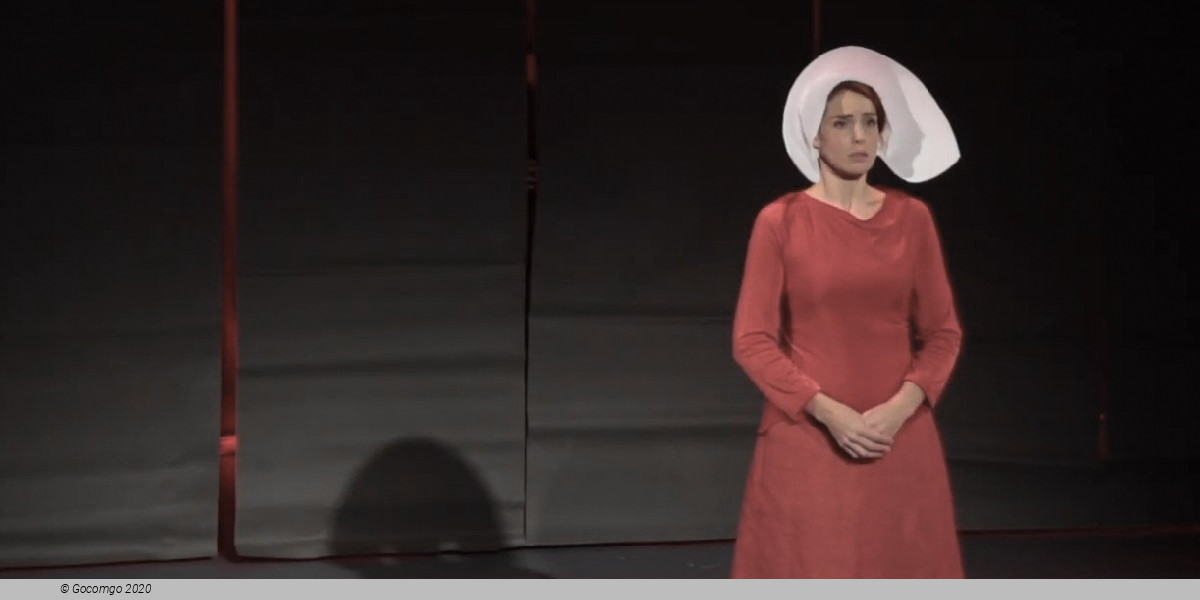
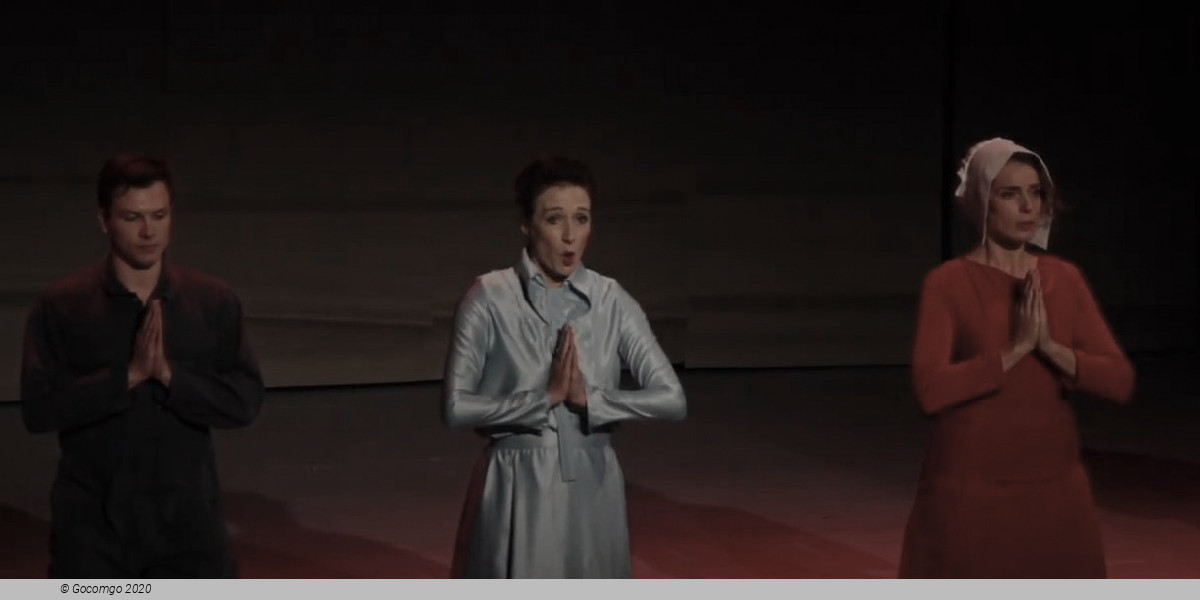
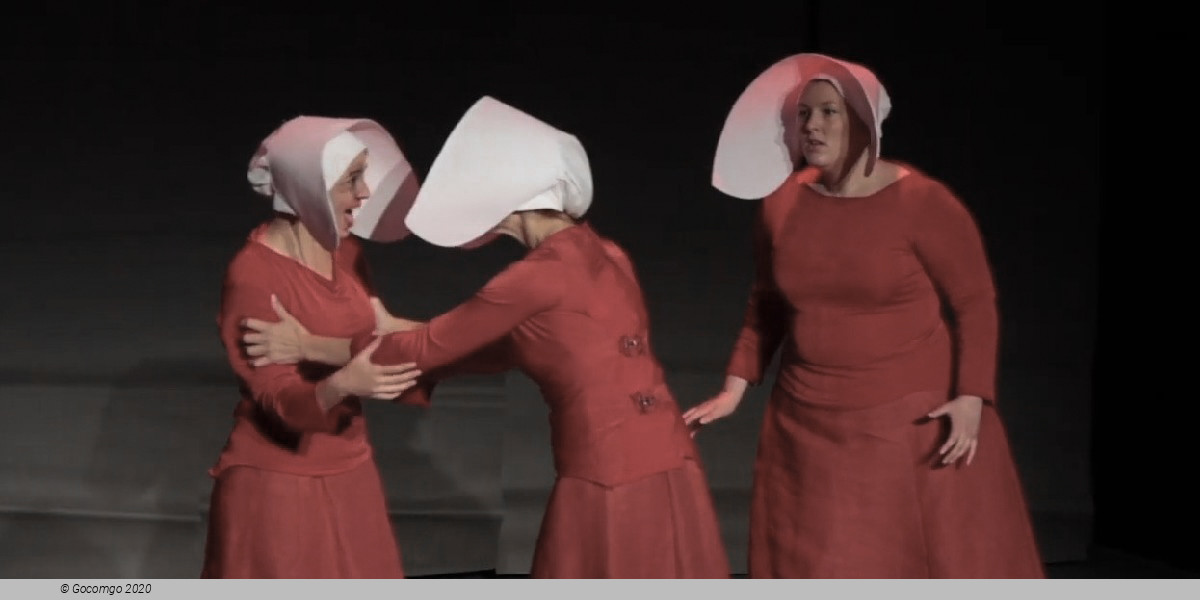
Women have been entirely stripped of their freedom and rights in Gilead. Fertile women, Handmaids, are forced to reproduce with Commanders of the Republic. Terror is a daily reality for Handmaid Offred. She defies the regime, refusing to surrender her identity and independence.

This thought-provoking work, revived after a successful run in 2022, asks questions around State power and the fragility of freedom.

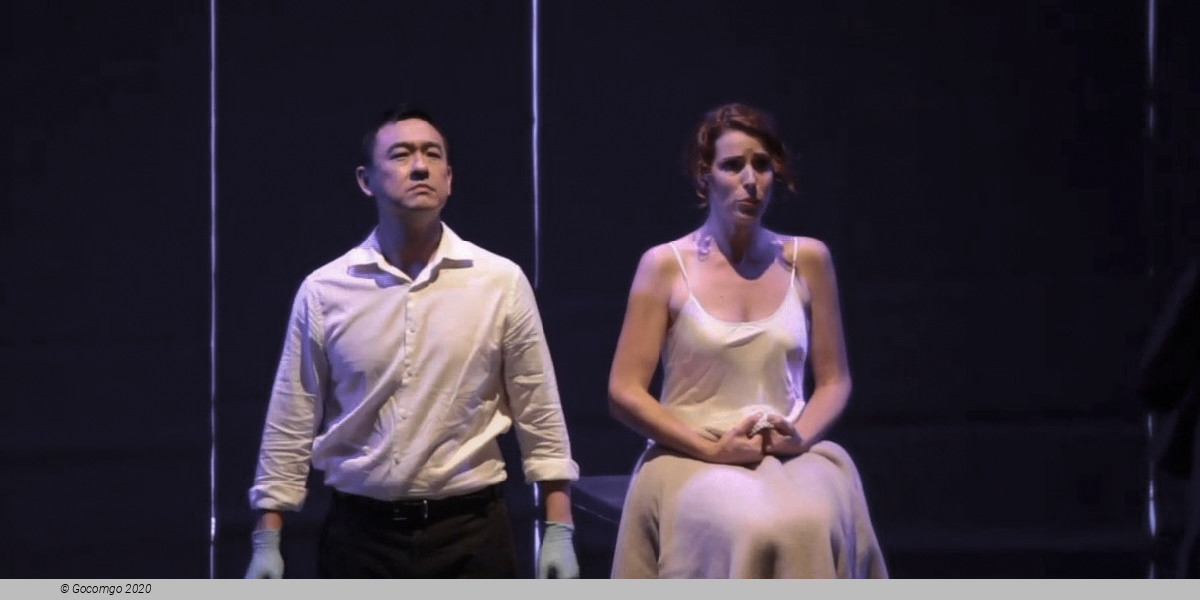
Directed by Annilese Miskimmon, the ENO’s Artistic Director, and conducted by Joana Carneiro the production has an exceptional cast including mezzo-sopranos Kate Lindsey as Offred and Susan Bickley as her mother, with soprano Rachel Nicholls as Aunt Lydia, Avery Amereau as Serena Joy, James Creswell as The Commander and ENO Harewood Artist John Findon as Luke.

History
Premiere of this production: 06 March 2000, Danish Royal Opera, Copenhagen

The Handmaid's Tale is a 1998 opera by Danish composer Poul Ruders, setting a libretto by Paul Bentley based on the novel of the same name by Margaret Atwood. The action takes place in the 21st-century United States taken over by a right-wing theocracy named Gilead; it starts with a newsreel-like collage: the narrative first frame.

Synopsis

Prologue

In AD 2195, the 12th Symposium on the Republic of Gilead is meeting via videoconference. The Republic was formed after Christian fundamentalists assassinated the President and most of Congress in order to establish a dictatorship based on Biblical principles within the United States. Women in the Republic have no suffrage, right to work, right to education, or right to property. Women who live in sin are taken to Red Centres where they are indoctrinated as Handmaids by Aunts. The Handmaids are sent to barren households, where they are required to be ritually inseminated once a month. Professor Pieixoto introduces an audio cassette recorded by a Handmaid who is in hiding. She had been taken from her second husband Luke and their daughter.

The Red Centre Prelude

The centre is run by Aunt Lydia. Moira, a friend of the Handmaid who recorded the tape, is captured after an escape attempt. Janine, another woman at the Centre, suffers a breakdown. Moira eventually manages to escape while other Handmaids graduate from the Centre.

Here the Red Centre showcases the multiple practices of indoctrination, which leads to Offred being posted to the home of a higher up Commander. The handmaids are taught a new set of rules based on the Ten Commandments.

Act 1

The Handmaid is assigned to a new posting under the command of Fred. She is therefore known as Offred (Of Fred). The wife of the household is Serena Joy, a former Gospel singer. Offred and Ofglen, another Handmaid, go shopping where they encounter the pregnant Janine. A doctor offers to impregnate Offred, but she declines in fear. At her new posting, the handyman Nick and Fred both have illegal contact with Offred when they talk to her and approach her bedroom. The household gathers for the ritual impregnation, and Nick tells Offred that Fred wants to see her privately afterwards, which is also illegal.

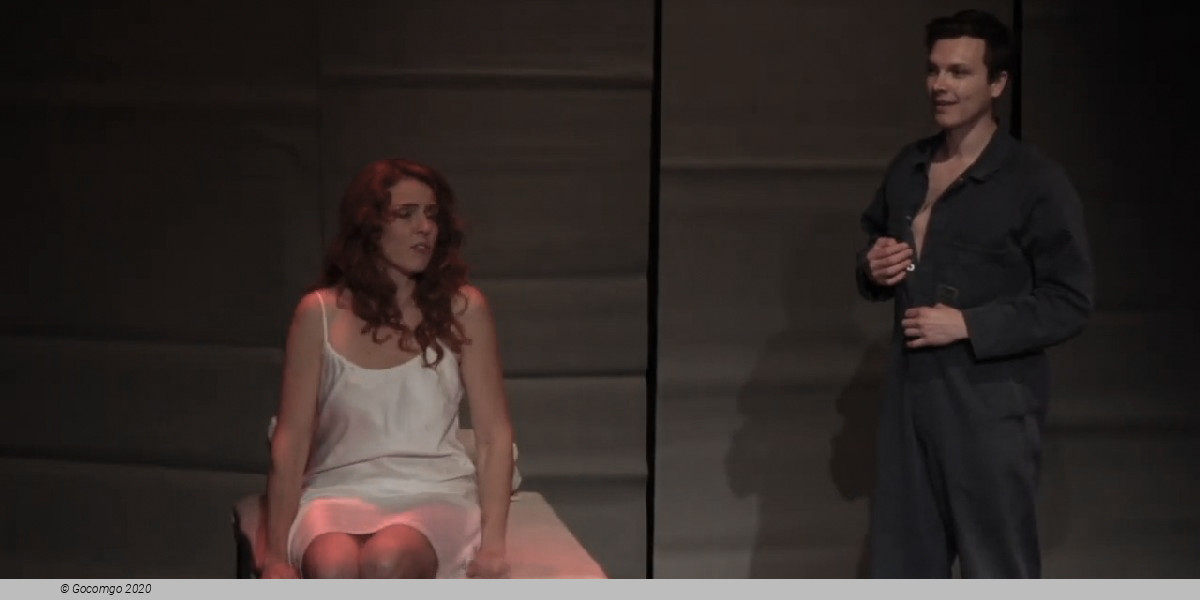
Instead of treating Offred as a sexual surrogate, the Commander finds himself attracted to her, which is an unpardonable sin leading to much of the disaster throughout the story.

The next day, the birth of Janine's child prompts all the Wives and Handmaids of the district to gather in celebration. Offred visits Fred that night in private, and once she is back in her bedroom, she collapses in a fit of hysterical laughter. This is Offred's way of acknowledging the hopelessness of her situation after the Commander makes her kiss him 'as if she meant it,' as well as it's a way to represent a woman's response to the experience of Gilead as a whole. The inconclusive ending of Act One foreshadows the ending of Act Two.

Act 2

Rita discovers Offred the next morning on the floor of her room. Offred visits Fred again in private, and during their next ritual, he caresses Offred. She fears that Serena Joy will notice the tender gesture. During another round of shopping, Offred and Ofglen confide that they are both breaking the law, as Ofglen talks about the resistance movement. Janine joins them before breaking down again, as a result of the execution of her defective child. Janine is taken off for execution.

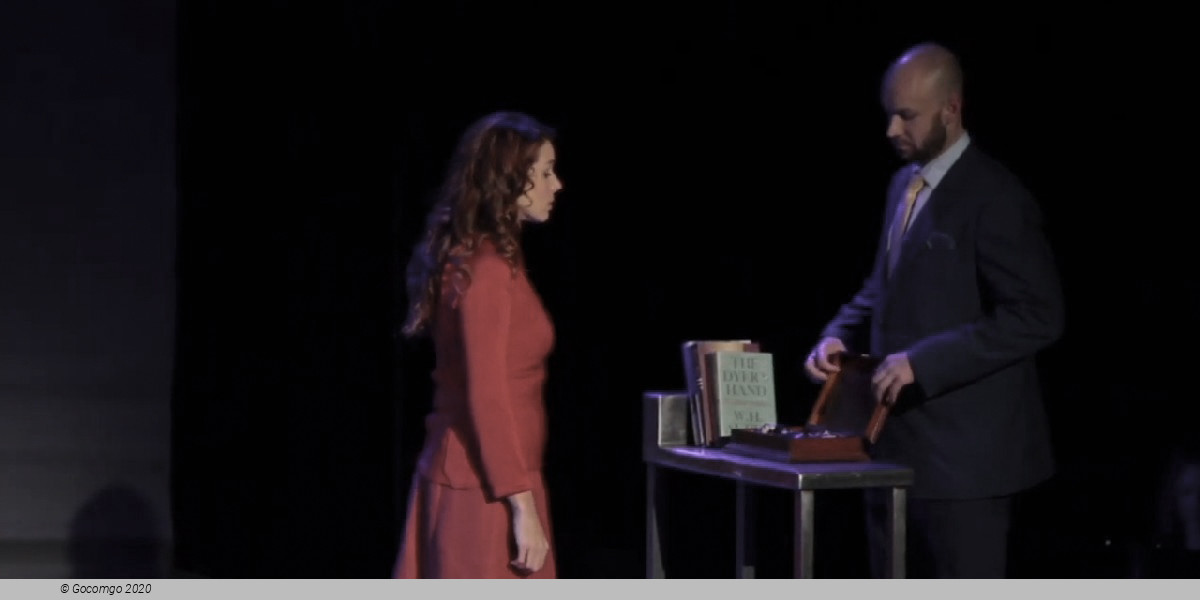
Offred continues to see Fred privately. Serena Joy tries to bribe Offred into a union with Nick by showing her a photo of Offred's missing daughter. Offred and Nick begin an affair. At a public execution, the Handmaids are given the opportunity to hang a 'rapist', who is part of the underground. Ofglen kicks him into unconsciousness in order to spare him the pain of hanging. Meanwhile, Serena Joy discovers Offred's affair with Fred. The "Eyes of God", the secret police, arrest Offred.

Epilogue

In the video conference context, Professor Pieixoto asks for any questions, prompting the end of the opera with the lights turning on in the theatre. Professor Pieixoto reveals that no one knows what happened to Offred.

Venue Info

London Coliseum - London
Location   St Martin’s Lane

The London Coliseum (also known as the Coliseum Theatre) is a theatre in St Martin's Lane, Westminster, built as one of London's largest and most luxurious "family" variety theatres.

Opened on 24 December 1904 as the London Coliseum Theatre of Varieties, it was designed by the theatrical architect Frank Matcham for the impresario Oswald Stoll. Their ambition was to build the largest and finest music hall, described as the "people's palace of entertainment" of its age.

The London Coliseum was built by the theatrical architect Frank Matcham who intended it to be one of London's largest and most luxurious "family" variety theatres. Construction began in 1903 and the venue opened on 24 December the following year as the London Coliseum Theatre of Varieties. It is located in St Martin's Lane, London.

Matcham built the theatre for the theatrical impresario Sir Oswald Stoll and had the ambition of it being the largest and finest "People’s palace of entertainment" of the age.

Matcham wanted a Theatre of Variety – not a music hall but equally not highbrow entertainment. The resulting programme was a mix of music hall and variety theatre, with one act - a full scale revolving chariot race - requiring the stage to revolve. The theatre's original slogan was PRO BONO PUBLICO (For the public good). It was opened in 1904 and the inaugural performance was a variety bill on 24 December that year.

English Heritage, in its description of the theatre when it was given listed status in 1960 notes that it is "exuberant Free Baroque ambitious design, the Edwardian "Theatre de Luxe of London" with richly decorated interiors and a vast and grandiose auditorium." The description continues: "Lavish foyer and circulation areas with marble facings, culminating in vast 3-tier auditorium with wealth of eclectic classical detail of Byzantine opulence, some motifs such as the squat columns dividing the lowest tier of slip boxes, backing the stalls, almost Sullivanesque; pairs of 2-tiered bow fronted boxes with domed canopies at gallery level and semi-domed, Ionic-columned pairs of 2 tiered orchestra boxes, contained in arched and pedimented frames surmounted by sculptural groups with lion-drawn chariots. Great, semi-circular, blocked architrave proscenium arch with cartouche- trophy keystone."

The inaugural performance was a variety bill on 24 December 1904, but it "was a total failure and closed down completely only two years after opening in 1906 and remained closed until December of 1907 when it was reopened and at last became successful." In 1908, the London Coliseum was host to a cricket match between Middlesex and Surrey. In 1911, dramatist W. S. Gilbert produced his last play here, The Hooligan.

The theatre changed its name from the London Coliseum to the Coliseum Theatre between 1931 and 1968 when a run of 651 performances of the musical comedy White Horse Inn began on 8 April 1931. Additionally, Arthur Lewis notes that:

Pantomimes began in 1936 with Cinderella and continued regularly until 1946. In 1947 the musical Annie Get Your Gun was staged at the Coliseum and had a staggeringly successful run for the time, of 1,304 performances and three continuous years which was the longest run in theatrical history. There then followed a long run of major American hits beginning with Kiss Me, Kate in 1951, Guys And Dolls in 1953, Pajama Game in 1955, and Damn Yankees in 1957. But this exceptional period did at last come to an end in 1957 when the production of The Bells Are Ringing failed to enthrall anyone.
The Coliseum reverted to the original name when the Sadler's Wells Opera Company moved there in 1968 and, in 1974, the Company changed its name to become the English National Opera; it bought the freehold of the building for £12.8 million in 1992. The Coliseum hosted both the 2004 and 2006 Royal Variety Performances and is also the London base for performances by English National Ballet, which perform regular seasons throughout the year when not on tour.

The Who performed there and recorded their concert, on 14 December 1969.

Important Info
Type: Opera
City: London, Great Britain
Starts at: 19:30
Intervals: 1
Duration: 2h 45min
Sung in: English
Top of page