

Metropolitan Opera tickets 31 December 2026 - La fanciulla del West | GoComGo.com

La fanciulla del West

Metropolitan Opera, Metropolitan Opera, New York, USA
All photos (7)
Select date and time
6:30 PM
From
US$ 101

E-tickets: Print at home or at the box office of the event if so specified. You will find more information in your booking confirmation email.

You can only select the category, and not the exact seats.
If you order 2 or 3 tickets: your seats will be next to each other.
If you order 4 or more tickets: your seats will be next to each other, or, if this is not possible, we will provide a combination of groups of seats (at least in pairs, for example 2+2 or 2+3).

Important Info
Type: Opera
City: New York, USA
Starts at: 18:30
Acts: 3
Intervals: 2
Duration: 3h 30min
Sung in: Italian
Titles in: Hungarian,English

E-tickets: Print at home or at the box office of the event if so specified. You will find more information in your booking confirmation email.

You can only select the category, and not the exact seats.
If you order 2 or 3 tickets: your seats will be next to each other.
If you order 4 or more tickets: your seats will be next to each other, or, if this is not possible, we will provide a combination of groups of seats (at least in pairs, for example 2+2 or 2+3).

Overview

The piece is staged at the Opera House in a production directed by Vasily Barkhatov, who is regularly engaged to work all over Russia and Europe.

After watching David Belasco's play The Girl of the Golden West on his 1907 visit to New York, Puccini resolved to set this somewhat unusual love story of the Wild West to music on the opera stage. The dramatic material proved to be a good choice, with an effectively moving plot that takes viewers to the denouement with a sure hand. The character of Minnie is also a highly suitable addition to Puccini's ranks of heroines: driven by love and passion, she thus has no fear of risking even her own life. 

History
Premiere of this production: 10 December 1910, Metropolitan Opera

La fanciulla del West (The Girl of the West) is an opera in three acts by Giacomo Puccini to an Italian libretto by Guelfo Civinini and Carlo Zangarini, based on the play The Girl of the Golden West by the American author David Belasco. Fanciulla followed Madama Butterfly, which was also based on a Belasco play. 

Synopsis

Time:1849 to 1850.
Place: A mining camp at the foot of the Cloudy Mountains, California.
Act 1
Inside the Polka Saloon

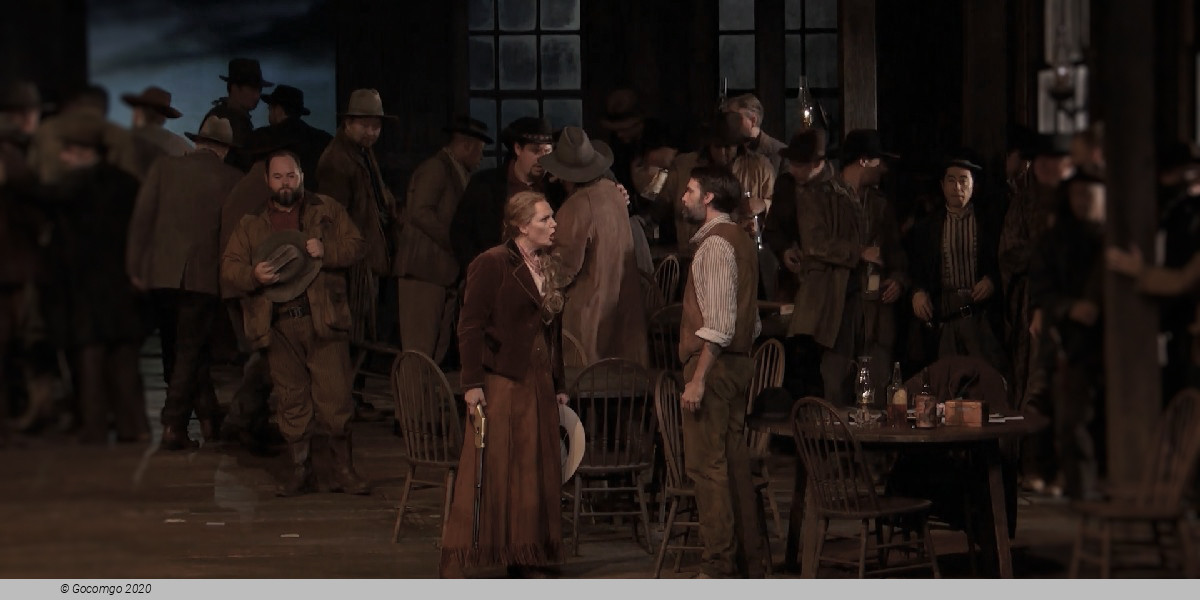
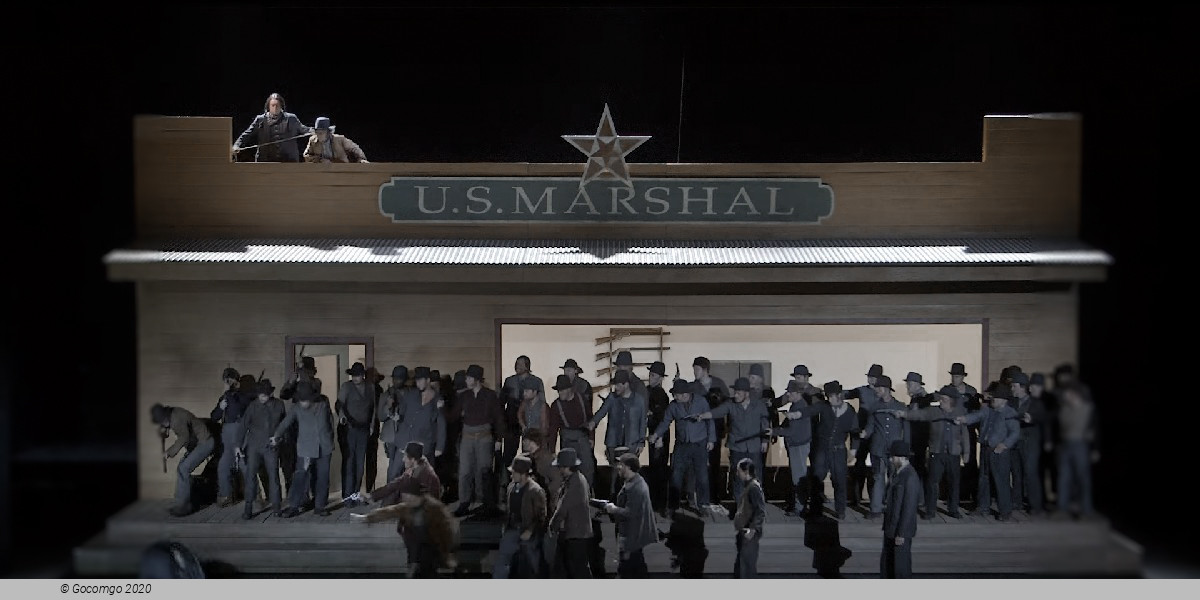
A group of Gold Rush miners enter the "Polka" saloon after a day working at the mine ("Hello! Hello! Alla 'Polka'"). After a song by traveling minstrel Jake Wallace ("Che faranno i vecchi miei"), one of the miners, Jim Larkens, is homesick and the miners collect enough money for his fare home ("Jim, perchè piangi?").

A group of miners playing cards discover that Sid is cheating and want to attack him. Sheriff Jack Rance quiets the fight and pins two cards to Sid's jacket, as a sign of a cheat.

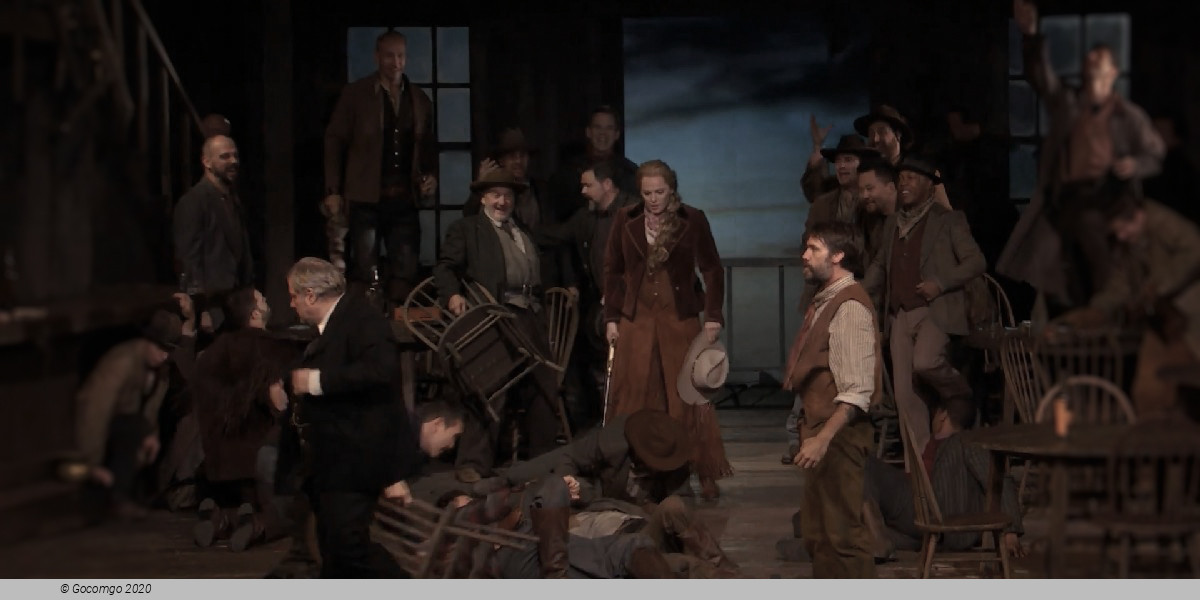
A Wells Fargo agent, Ashby, enters and announces that he is chasing the bandit Ramerrez and his gang of Mexicans. Rance toasts Minnie, the woman who owns the saloon, as his future wife, which makes Sonora jealous. The two men begin to fight. Rance draws his revolver but at that moment, a shot rings out and Minnie stands next to the bar with a rifle in her hands ("Hello, Minnie!"). She gives the miners a reading lesson from the Bible ("Dove eravamo?").

The Pony Express rider arrives ("La posta!") and delivers a telegram from Nina Micheltorena, offering to reveal Ramerrez's hideout. The sheriff tells Minnie that he loves her, but Minnie puts him off as she is waiting for the right man ("Ti voglio bene, Minnie").

A stranger enters the saloon and asks for a whisky and water. He introduces himself as Dick Johnson from Sacramento, whom Minnie had met earlier. Johnson invites Minnie to dance with him and she accepts. Angrily, Rance watches them.

Ashby returns with the captured Ramerrez gang member, Castro. Upon seeing his leader, Johnson, in the saloon, Castro agrees to lead Rance, Ashby and the miners in a search for Ramerrez, and the group then follows him on a false trail and in what turns out to be a wild goose chase. But before Castro leaves, he whispers to Johnson that somebody will whistle and Johnson must reply to confirm that the place is clear. A whistle is heard, but Johnson fails to reply.

Minnie shows Johnson the keg of gold that she and the miners take turns to guard at night and Johnson reassures her that the gold will be safe there. Before he leaves the saloon, he promises to visit her at her cabin. They confess their love for each other. Minnie begins to cry, and Johnson comforts her before he leaves.

Act 2
Minnie's dwelling, later that evening

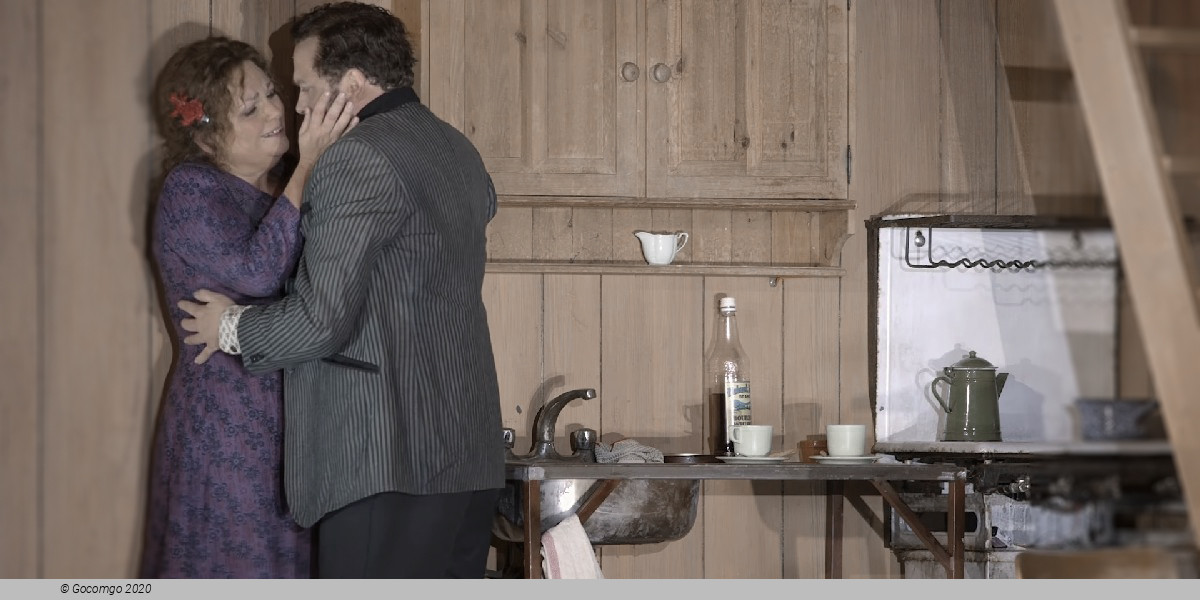
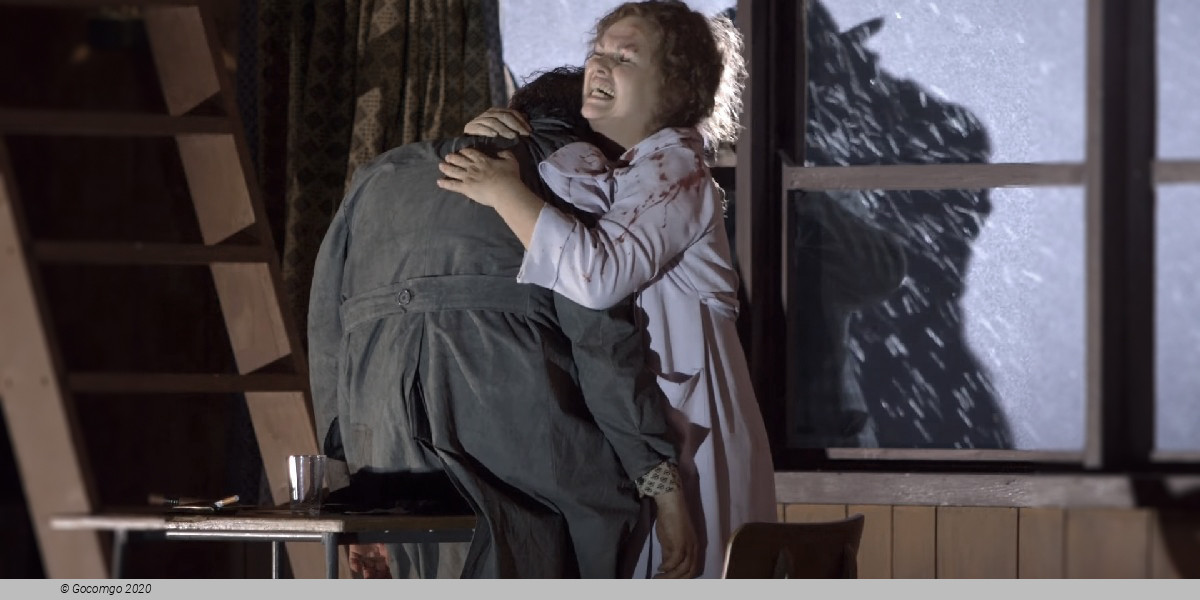
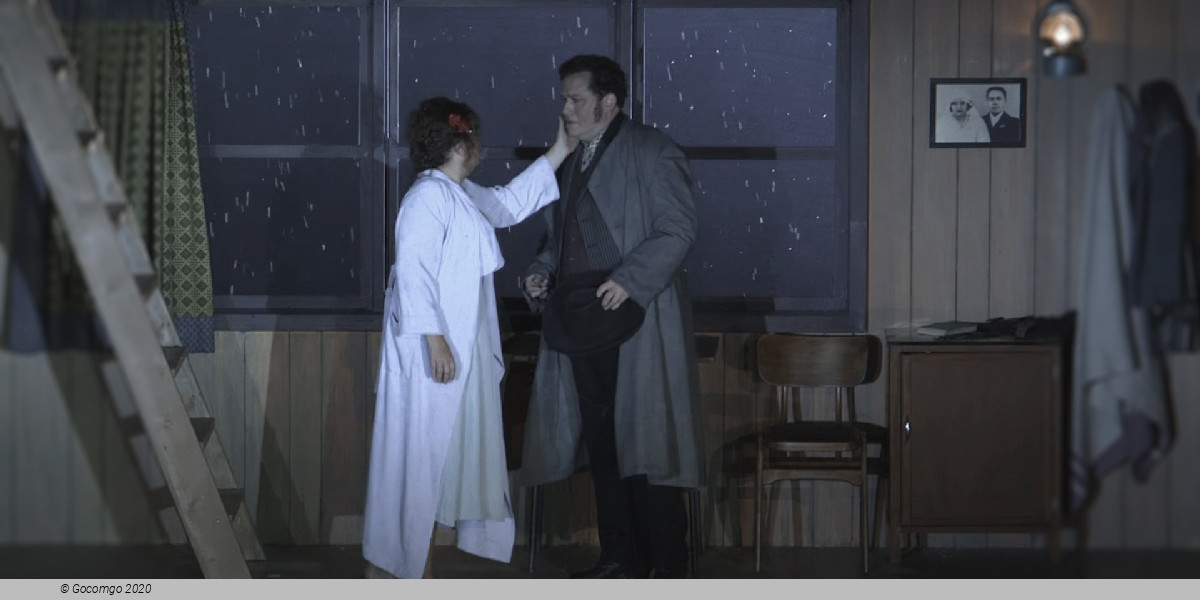
Wowkle, a Native American woman who is Minnie's servant, her lover Billy Jackrabbit and their baby are present as Minnie enters, wanting to get ready for Johnson's visit. Johnson enters Minnie's cabin and she tells him all about her life. It begins to snow. They kiss and Minnie asks him to stay till morning. He denies knowing Nina Micheltorena. As Johnson hides, a posse enters looking for Ramerrez and reveal to Minnie that Johnson is the bandit Ramerrez himself. Angry, she orders Johnson to leave. After he leaves, Minnie hears a gunshot and she knows Johnson has been shot. Johnson staggers in and collapses, Minnie helps him by hiding him up in the loft. Rance enters Minnie's cabin looking for the bandit and is about to give up searching for Johnson when drops of blood fall on his hand. Rance forces Johnson to climb down. Minnie desperately makes Rance an offer: if she beats him at poker, he must let Johnson go free; if Rance wins, she will marry him. Hiding some cards in her stockings, Minnie cheats and wins. Rance honors the deal and Minnie throws herself on the unconscious Johnson on the floor.

Act 3
In the Great Californian Forest at dawn, sometime later

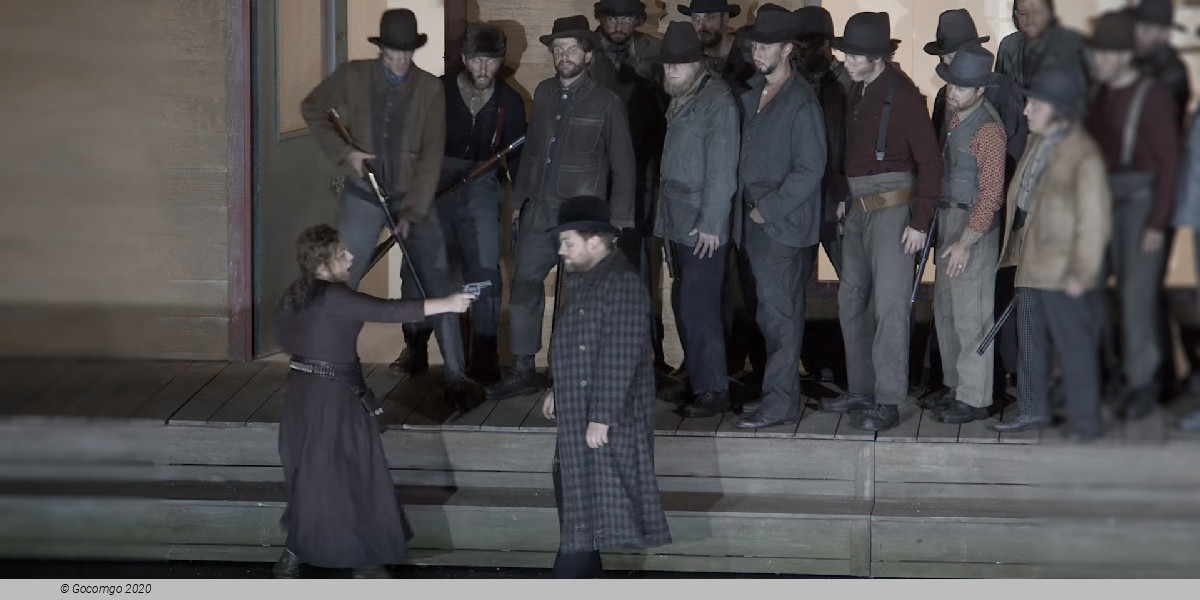
Johnson is again on the run from Ashby and the miners. Nick and Rance are discussing Johnson and wonder what Minnie sees in him when Ashby arrives in triumph: Johnson has been captured. Rance and the miners all want Johnson to be hanged. Johnson accepts the sentence and only asks the miners not to tell Minnie about his capture and his fate ("Ch'ella mi creda"). Minnie arrives, armed with a pistol, just before the execution and throws herself in front of Johnson to protect him. While Rance tries to proceed, she convinces the miners that they owe her too much to kill the man she loves, and asks them to forgive him ("Ah! Ah! E Minnie!"). One by one, the miners yield to her plea ("E anche tu lo vorrai, Joe"). Rance is not happy but finally he too gives in. Sonora unties Johnson and sets him free. The miners bid Minnie farewell ("Le tue parole sono di Dio"). Minnie and Johnson leave California to start a new life together.

Venue Info

Metropolitan Opera - New York
Location   30 Lincoln Center

The Metropolitan Opera is an opera company based in New York City, resident at the Metropolitan Opera House at the Lincoln Center for the Performing Arts. The Metropolitan Opera is the largest classical music theatre in North America. It presents about 27 different operas each year from late September through May. As of 2018, the company's current music director is Yannick Nézet-Séguin.

The Metropolitan Opera Company was founded in 1883 as an alternative to New York's old established Academy of Music opera house. The subscribers to the Academy's limited number of private boxes represented the highest stratum in New York society. By 1880, these "old money" families were loath to admit New York's newly wealthy industrialists into their long-established social circle. Frustrated with being excluded, the Metropolitan Opera's founding subscribers determined to build a new opera house that would outshine the old Academy in every way. A group of 22 men assembled at Delmonico's restaurant on April 28, 1880. They elected officers and established subscriptions for ownership in the new company. The new theater, built at 39th and Broadway, would include three tiers of private boxes in which the scions of New York's powerful new industrial families could display their wealth and establish their social prominence. The first Met subscribers included members of the Morgan, Roosevelt, and Vanderbilt families, all of whom had been excluded from the Academy. The new Metropolitan Opera House opened on October 22, 1883, and was an immediate success, both socially and artistically. The Academy of Music's opera season folded just three years after the Met opened.

The operas are presented in a rotating repertory schedule, with up to seven performances of four different works staged each week. Performances are given in the evening Monday through Saturday with a matinée on Saturday. Several operas are presented in new productions each season. Sometimes these are borrowed from or shared with other opera companies. The rest of the year's operas are given in revivals of productions from previous seasons. The 2015–16 season comprised 227 performances of 25 operas.

The operas in the Met's repertoire consist of a wide range of works, from 18th-century Baroque and 19th-century Bel canto to the Minimalism of the late 20th century. These operas are presented in staged productions that range in style from those with elaborate traditional decors to others that feature modern conceptual designs.

The Met's performing company consists of a large symphony-sized orchestra, a chorus, a children's choir, and many supporting and leading solo singers. The company also employs numerous free-lance dancers, actors, musicians, and other performers throughout the season. The Met's roster of singers includes both international and American artists, some of whose careers have been developed through the Met's young artists programs. While many singers appear periodically as guests with the company, others, such as Renée Fleming and Plácido Domingo, long maintained a close association with the Met, appearing many times each season until they retired.

Important Info
Type: Opera
City: New York, USA
Starts at: 18:30
Acts: 3
Intervals: 2
Duration: 3h 30min
Sung in: Italian
Titles in: Hungarian,English
Top of page