
Teatro del Maggio Musicale Fiorentino 10 November 2022 - Ernani | GoComGo.com

Ernani

Teatro del Maggio Musicale Fiorentino, Auditorium, Florence, Italy
All photos (4)
Select date and time
8 PM

E-tickets: Print at home or at the box office of the event if so specified. You will find more information in your booking confirmation email.

You can only select the category, and not the exact seats.
If you order 2 or 3 tickets: your seats will be next to each other.
If you order 4 or more tickets: your seats will be next to each other, or, if this is not possible, we will provide a combination of groups of seats (at least in pairs, for example 2+2 or 2+3).

Important Info
Type: Opera
City: Florence, Italy
Starts at: 20:00
Intervals: 1
Duration: 2h 30min

E-tickets: Print at home or at the box office of the event if so specified. You will find more information in your booking confirmation email.

You can only select the category, and not the exact seats.
If you order 2 or 3 tickets: your seats will be next to each other.
If you order 4 or more tickets: your seats will be next to each other, or, if this is not possible, we will provide a combination of groups of seats (at least in pairs, for example 2+2 or 2+3).

Overview

In addition to the love quadrilateral characterized by the eternal conflict between love and honor, duels, riots, disguises and twists follow one another in the work accompanied by fast-paced music, with continuous changes of gear and with the passionate air of solo and choral melodies which guaranteed the public favor for the fifth Verdi title right from the very first reruns.

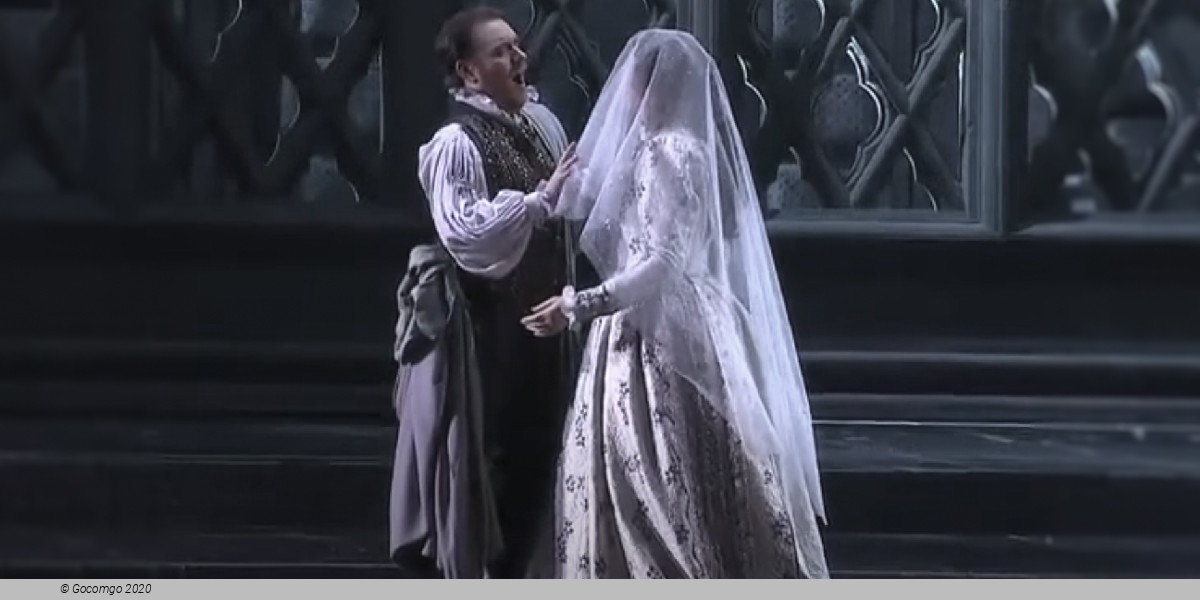
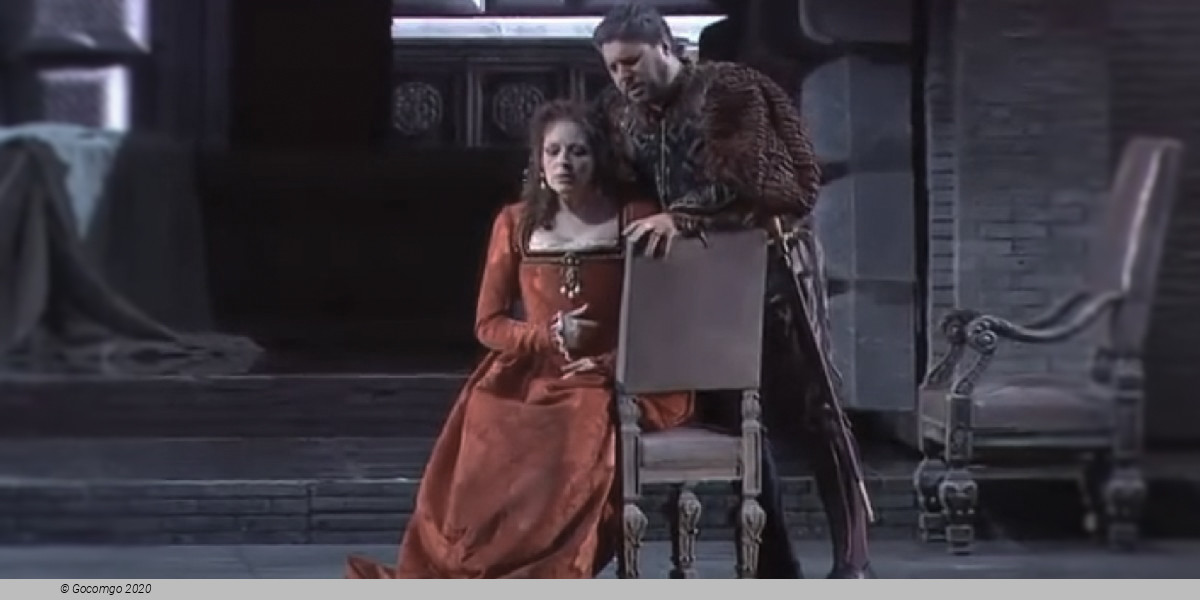
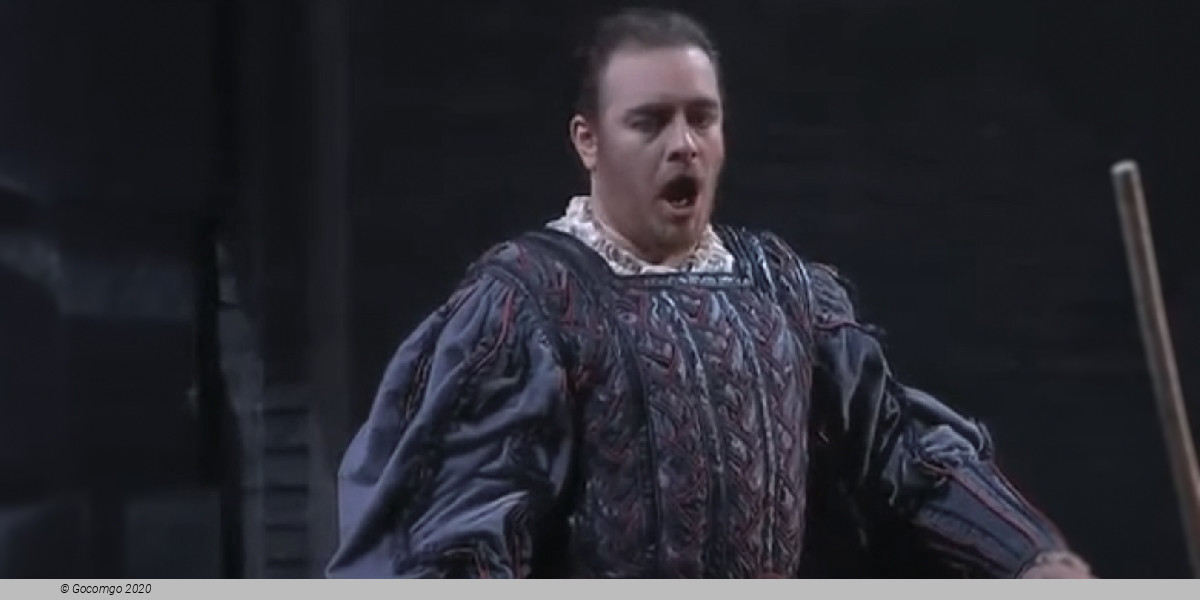
Lyric drama in four parts on a libretto by Francesco Maria Piave, Ernani made his debut at the Teatro la Fenice in Venice on March 9, 1844. For Verdi it was the first engagement in a theater other than the Scala that allowed him not only to try his hand with a new audience and new needs, but also to meet the young Murano poet Piave, with whom he would have established a long working relationship and friendship. The libretto was based on the play by Victor Hugo Hernani, considered at the time a cornerstone of French literary and theatrical romanticism. The plot, set in Spain in the early sixteenth century, intertwines the two narrative levels of action and sentiment. Ernani, banished at the head of the conspiracy against King Charles and under whose disguise the noble Don Giovanni d’Aragona is hiding, madly loves Elvira, already betrothed to his uncle Don Ruy de Silva, but also desired by the king.

New staging

History
Premiere of this production: 09 March 1844, Teatro La Fenice, Venice

Ernani is an operatic dramma lirico in four acts by Giuseppe Verdi to an Italian libretto by Francesco Maria Piave, based on the play Hernani by Victor Hugo.

Synopsis

Time: 1519.
Place: Aragon, Aachen, and Zaragoza.

Act 1
Mountains of Aragon

The bandits demand the reason for Ernani's gloom (Chorus: Evviva! Beviam! Beviam! / "To you we drink"; Ernani pensoso! / "Ernani, so gloomy? Why, oh strong one, does care sit on your brow?"). Ernani replies that he loves Elvira (Recitative: "Thanks, dear friends"; Cavatina: Come rugiada al cespite / "As the flower turns to the sun"), who is about to be married against her will to old Gomez de Silva (O tu che l'alma adora). He asks the bandits to abduct her.

In Elvira's chamber

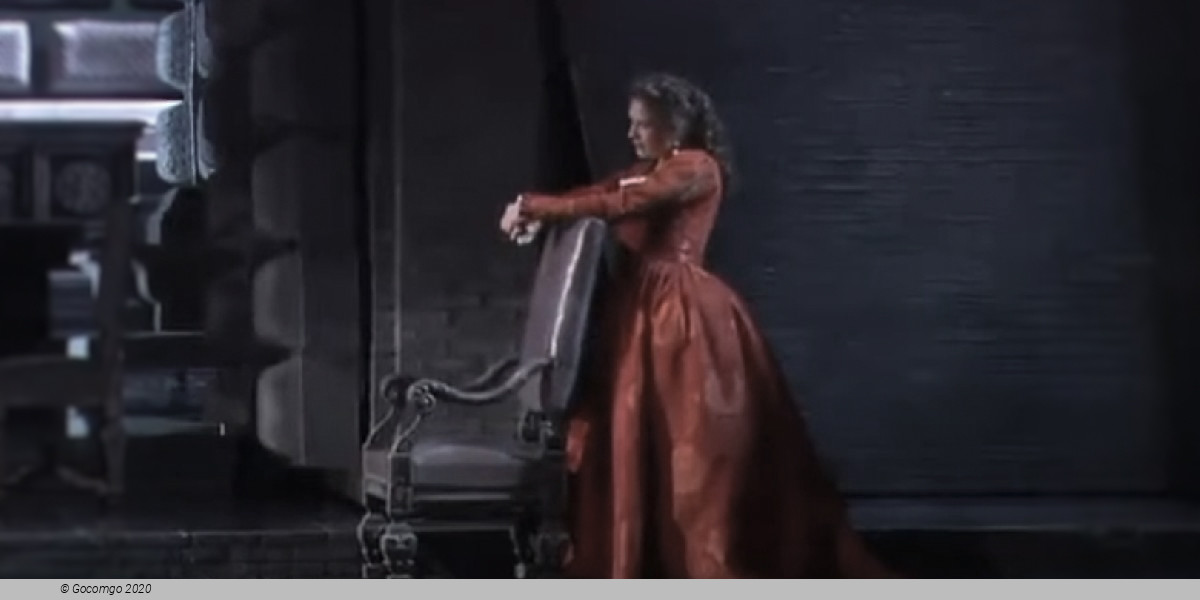
Elvira worries about her upcoming marriage (Scena: "Now sinks the sun and Silva does not return"; Cavatina: Ernani, Ernani involami / "Ernani, Ernani, save me") as servants deliver Silva's wedding presents to her. She reaffirms her love for Ernani (Tutto sprezzo che d'Ernani / "I scorn everything which does not speak to my heart of Ernani"). King Carlos, disguised as a peasant, enters, but Elvira recognizes him and rejects the love that he offers her. As he attempts to use force, she grasps a dagger, but Ernani suddenly arrives and stops Carlos (Trio: "A friend comes quickly to your aid"). Carlos recognizes Ernani as the leader of the bandits. Ernani replies that Carlos robbed him of his lands and forced him into a life of banditry. As he invites Carlos to fight, Silva appears and sees Ernani (Infelice!... e tu credevi... che mai vegg'io! / "Dreadful sight"; Silva's cavatina: "Unhappy man! You thought this lovely...was yours").

Ernani offers to fight them both when Riccardo approaches and recognises the king. Silva is horrified and apologizes to the king, while Ernani whispers to Elvira to prepare to flee.

Act 2

A hall in Silva's palace

Ernani enters disguised as a pilgrim. He asks for shelter, which Silva grants him, and then learns from Silva that he is about to marry Elvira, who believes Ernani to be dead. Ernani reveals his true identity to Elvira and she tells him that she plans to kill herself at the altar (Duet: Ah, morir potessi adesso / "Ah, if I could die now"). Silva walks in at that moment, discovers the pair, but agrees to keep his word to Ernani and protect him from the king, for which Ernani will owe him a perpetual debt. (Trio: No, vendetta più tremenda / "No, I want to keep a greater revenge"). Carlos arrives and wishes to know why the castle is barred. Silva refuses to surrender Ernani (Carlos' aria: Lo vedremo, veglio audace / "We shall see, you bold old man") and Don Carlos's men cannot find Ernani's hiding place. Silva keeps his word, even when the king secures Elvira as a hostage. Silva releases Ernani, and then challenges him to a duel. Ernani refuses to fight, but unites with Silva in his plans to free Elvira from the king. Ernani swears to appear at the summons of Silva, wherever he may be at that time (Odi il voto o grande Iddio / "Oh God, hear the vow"),

[Added for Parma, 26 December 1844: "at Rossini's request, Verdi wrote a grand aria for the tenor Nicola Ivanoff". Ernani gathers his men to him. His aria of vengeance: Sprezzo la vita né più m'alletta / "Life means nothing to me, only hope of vengeance" concludes the act].

Act 3
In the burial vault of Charles the Great at Aachen

Carlos visits the grave of the emperor Charlemagne (Carlo Magno), whose successor, the new Holy Roman Emperor, is being elected by delegates from the relevant countries. Carlos resolves to change his life if he is crowned (Cavatina: Oh, de' verd'anni miei/ "Oh, the dreams and deceits of my youth"). Hiding behind the vault, he overhears a gathering of conspirators including Silva and Ernani. Ernani swears to murder Carlos. The conspiracy is foiled when Carlos's attendants enter and surprise the conspirators. The king commands that all the traitorous noblemen be executed. Ernani steps forward, declaring that thus he must die too; he is not the bandit Ernani, but Don Juan of Aragon, whose lands were taken from him. Elvira, who had been brought to Carlos as his intended empress, begs mercy for her lover, and Carlos, whose mood has changed, forgives them both and places Elvira's hand in that of Ernani.

Act 4
Ernani's Castle

Elvira and Ernani have just been married, when, in consternation, Ernani hears a bugle call. Silva arrives and silently hands Ernani a dagger. Ernani asks for time to "sip from the cup of love" (Ascolta, ascolta un detto ancor/ "Listen, just one word...") but, cursed by Silva as a coward, Ernani keeps his oath and stabs himself in the heart (Trio with Silva: È vano, o donna, il piangere, è vano / "Your weeping is in vain, woman"). He dies in Elvira's arms, telling her to live.

Venue Info

Teatro del Maggio Musicale Fiorentino - Florence
Location   Piazza Vittorio Gui, 1

Teatro del Maggio Musicale Fiorentino is a major opera house in Florence and the main concert venue of the international festival "Maggio Musicale Fiorentino".

The white marble veined with green of the Baptistery of San Giovanni, the brickwork of the dome of Santa Maria del Fiore and finally the dazzling gold of the precious paintings that have made the city of Tuscany one of the world capitals of art: the materials and colors of the Renaissance they meet at the Teatro del Maggio to celebrate the power of music, and the enchantment of melodrama, right in the city where this exceptional form of theater was born. Conceived by the architect Paolo Desideri of the ABDR studio, the “new house” of the Maggio Musicale Fiorentino rises at the meeting point between the monumental center and the Parco delle Cascine, the green lung of the city.

An important connective function also reaffirmed by the vast system of open areas that can be reached through the two areas of the city and the different volumes of the building. Moreover, the proximity to the Stazione Leopolda helps to create a cultural pole of European importance.

Above a sort of wide base, a sloping skirting, there are the large music rooms and the enigmatic volume of the 35 meter high stage tower. Three rooms, which can work simultaneously: the 1800-seat opera theater, distributed between the stalls, boxes and gallery, an outdoor 2000-seat auditorium and finally an auditorium, dedicated to maestro Zubin Mehta, which varies its capacity from 500 to 1000 spectators.

As in a great musical instrument, the walls of the main hall are covered in pear wood to guarantee perfect acoustics. A dense network of thin copper chains also helps to transport the sound without distortion. The stage has a depth doubled compared to the average of Italian and foreign theaters and, thanks to its flexibility, is able to accommodate in its side pockets up to two sets ready to be moved during the intervals. The Cavea is positioned in the theater’s roof to complement and conclude the extensive system of squares, terraces and belvedere.

Its usability is therefore not limited to representations only, but is extended to the entire day to turn its stone steps into real urban salons. Inaugurated on December 21, 2011 with the Ninth Symphony of Ludwig van Beethoven directed by Zubin Mehta, the Teatro del Maggio is the permanent venue of the Orchestra and Chorus of the Maggio Musicale Fiorentino and has already hosted Masters such as Claudio Abbado, Riccardo Muti, Gustavo Dudamel , Daniele Gatti, Fabio Luisi, leading groups such as the Berliner Philharmoniker, the St. Petersburg Philharmonic Orchestra and the National de France Orchestras. Among the many artists who performed there are Alessandra Ferri, Mariella Devia, Sumi Jo, Anja Harteros, Aldo Ciccolini, Uto Ughi, Maurizio Pollini, Krystian Zimerman, Gregory Kunde, Ambrogio Maestri. In 2014 he received the National Award for the best architectural work made in Italy in the last 5 years.

Important Info
Type: Opera
City: Florence, Italy
Starts at: 20:00
Intervals: 1
Duration: 2h 30min
Top of page