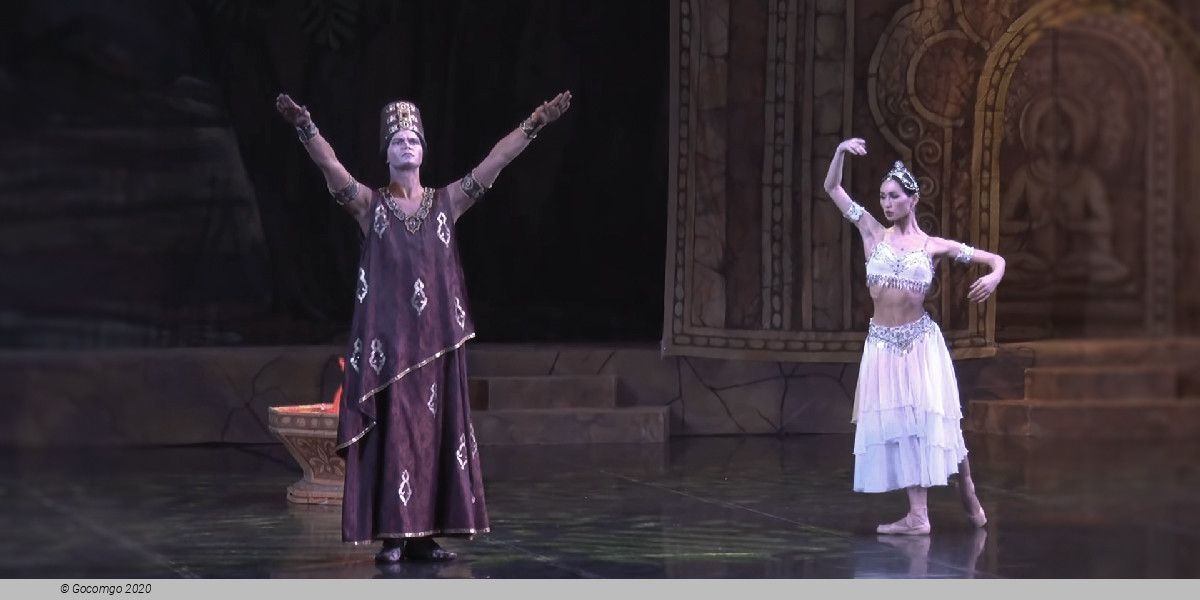
Teatro Real 21 May 2022 - La Bayadere (Bolshoi Ballet) | GoComGo.com

La Bayadere (Bolshoi Ballet)

Teatro Real, Main Auditorium, Madrid, Spain
All photos (9)
Select date and time
11:30 AM 7:30 PM

E-tickets: Print at home or at the box office of the event if so specified. You will find more information in your booking confirmation email.

You can only select the category, and not the exact seats.
If you order 2 or 3 tickets: your seats will be next to each other.
If you order 4 or more tickets: your seats will be next to each other, or, if this is not possible, we will provide a combination of groups of seats (at least in pairs, for example 2+2 or 2+3).

Important Info
Type: Ballet
City: Madrid, Spain
Starts at: 11:30
Acts: 3
Intervals: 2
Duration: 3h 15min

E-tickets: Print at home or at the box office of the event if so specified. You will find more information in your booking confirmation email.

You can only select the category, and not the exact seats.
If you order 2 or 3 tickets: your seats will be next to each other.
If you order 4 or more tickets: your seats will be next to each other, or, if this is not possible, we will provide a combination of groups of seats (at least in pairs, for example 2+2 or 2+3).

Overview

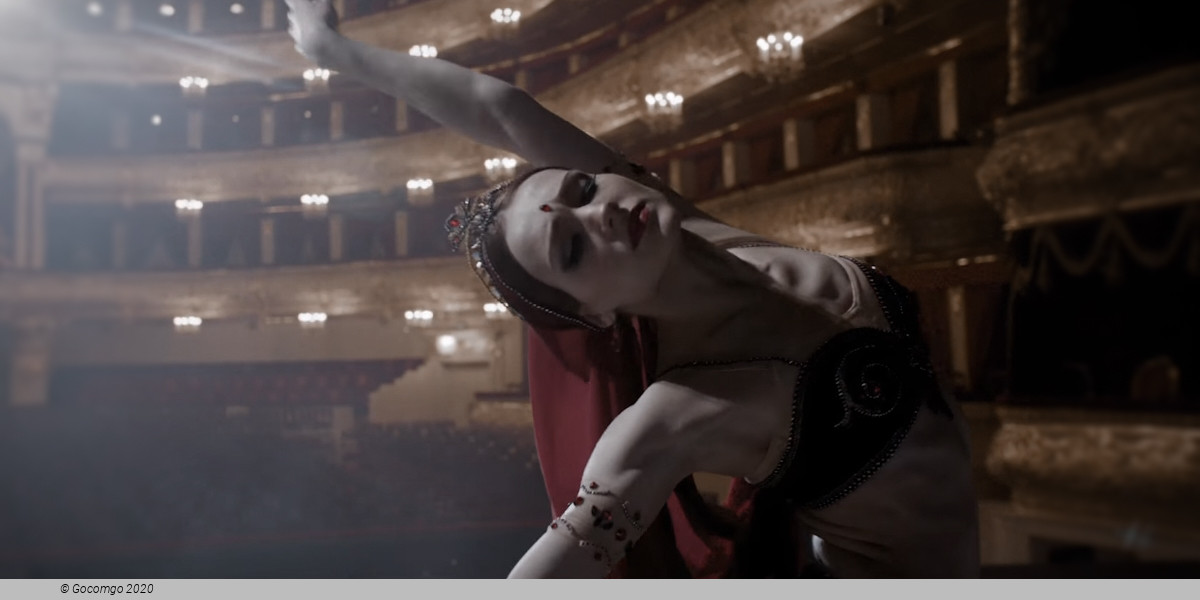
The version by this Russian company which comes to the Teatro Real this season was conceived by Yuri Grigorovich in 1991 which restored the original of Marius Petipa to the Mariinsky Theatre. Not only did he maintain the complete duration of the French master’s piece, as well, he added new dances which compliment the piece of art with oriental tones that is La Bayadère.

Monument to the epoch. La Bayadère (1877) is Marius Petipa’s (1818-1910) last tragic ballet and the first of his many masterpieces. It is the 58-year-old matre of Petersburg ballet’s colorful, slightly nostalgic farewell to the romantic illusions and melodrama that were close to his heart.

Right into his old age, Petipa was a gallant admirer of the fair sex. The symbol of ballet for him was the female ballerina. A native of the Mediterranean, with its cult of the Madonna, the Virgin Mary, Petipa, as a true Frenchman, saw in woman a being who was more refined and harmonic than was man. He was a devoted knight of the ballerina and the creator of ballets that were mainly for women. To men he allocated the modest role of gallant partners to beautiful ballerinas, and they danced comparatively little.

Such is the basis of Petipa’s ballet aesthetic and La Bayadère too was created according to its canons. Ballerina Ekaterina Vazem (1848-1937), the creator of the role of Nikia, writes about this in her memoirs. Her Solor at the ballet’s première at Petersburg’s Bolshoi Theatre (February 4, 1877) was Lev Ivanov (1834-1901) – the future choreographer of the immortal swan scenes in Swan Lake. La Bayadère was a model example of a 19th century stylistic trend called eclecticism, which the French refer to now as the style of Napoleon III, now as neo-baroque. The age of eclecticism has left posterity marvelous works of art: the magnificent building of the Paris Opéra and the Casino at Monte Carlo by architect Charles Garnier, the paintings and prints by Gustave Doré and the canvases by Gustave Moreau. It was in fact Doré’s illustrations to Dante’s Divine Comedy which inspired Petipa when he was creating his masterpiece.

Eclecticism, this somewhat unwieldy proto-modernism, combines things that, at first glance, appear to be incompatible – and the same applies, incidentally, to La Bayadère. Here everyone will find something to their own taste: romantic exotica, traits of pure academic classicism, melodrama and much else.

In the first La Bayadère there was just about everything! A melodramatic storyline about the love of two perjurers with a tragic ending, the classical conflict between love and duty, a class conflict – the rivalry between a Rajah’s daughter and a poor bayadère, and a finale that bordered on the blasphemous for an imperial theatre: the death of the rulers, Brahmin priests and courtiers, under the ruins of the temple which collapsed, at the command of the enraged Gods, during Solor and Gamzatti’s wedding ceremony. Added to which in the ballet there was a huge number of solo, ensemble classical and character dances, grand processions and pantomime episodes, particularly popular with balletomanes was the famous “jealousy scene between the two rivals”– Nikia and Gamzatti. But La Bayadère also contained more subtle material, including mystical symbolism. Right from Scene l, the audience was haunted by the disturbing feeling that the heroes were at the mercy of “a punitive sword from the heavens”.

The Ballet Within the Ballet

Of course, many creative personalities in the positivist 19th century were drawn to mysticism, felt a need to become acquainted with the occult sciences, whose homeland was considered to be the East. But it is hardly likely that Petipa who, in La Bayadère, had unwittingly created his own “metaphysics”, his own “nirvana” and “white man’s East”, belonged to their number. His Shades act, like Ivanov’s white swans – is ballet for all seasons. From the gorges of the Himalayas a procession of Shades appears (a shade is equivalent to soul in romantic terminology!) in white tunics and with circlets on their heads to which, as to the dancers’ arms, are attached white, ethereal veils, representing wings. (Nikia too dances a variation with a veil).

The almost meditative pace of their entrance, in which the vertical of the divine world alternates gracefully with the horizontal linear of the earth – arabesque, port de bras, pas, arabesque, port de bras, pas – is reminiscent of an unending prayer or eastern melody. This apparently simple, but essentially brilliant dance combination, is like waves in the endless ocean of being: ebb, flow, ebb, flow…

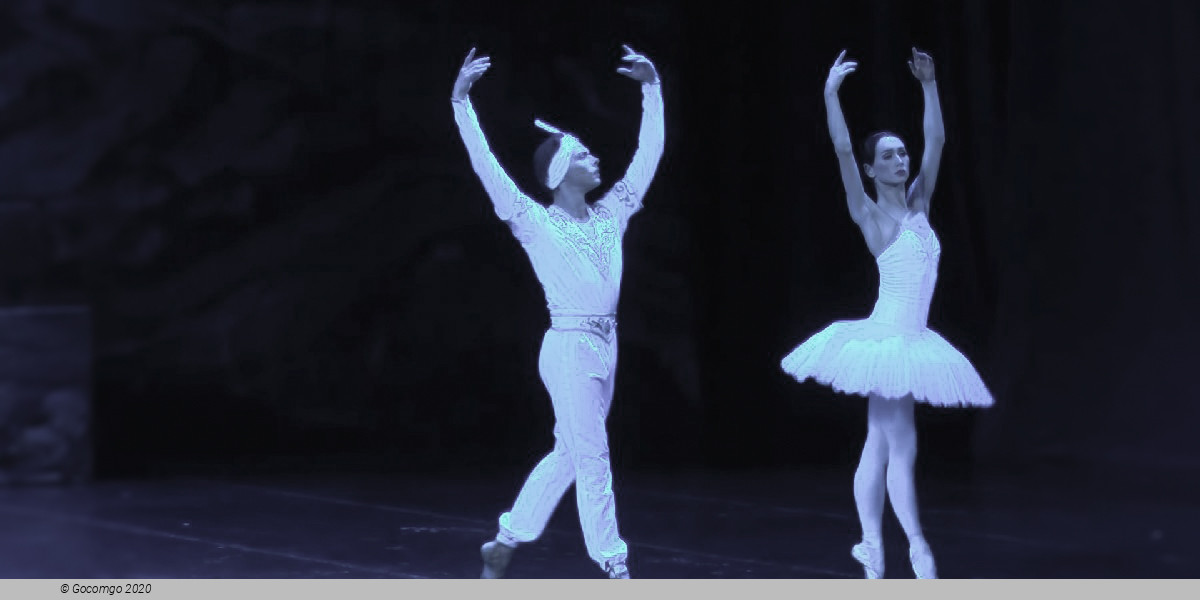
In a symbolic ‘‘snake’’, the white-winged Shades descend like mist from off the mountains, gradually covering the whole stage and forming up in a square or rectangle – a sign of the earth. The number of Shades speaks volumes too – at the first performance of the ballet at Petersburg’s Bolshoi Theatre there were 64 of them (a chess board or an ideal square!), later at the Mariinsky Theatre– there were 32. These are magic numbers in numerology and will be met with again In classical ballet– viz., the 32 swans in Swan Lake and the 64 snowflakes In Lev Ivanov’s Nutcracker… The dance of the Shades is hypnotizing: it never fails to plunge the audience into an unconsciously-ecstatic contemplation of beauty. The Shades Act, moreover, is a moment of spiritual regeneration for Solor. He begins it with a lyrical, nocturnal memory of his “beloved Shade” and completes it with an exultant (‘‘forever together”) coda.

La Bayadère’s Destiny After Petipa

Over the course of time, La Bayadère has undergone numerous changes. Petipa himself altered several of the dances and did two revivals at the Mariinsky Theatre of this ‘‘holy’’ ballet which has always been popular with audiences and loved by dancers. The last act of La Bayadère, with its earthquake and collapsing temple walls, was dropped in the post-revolutionary years when the technical means for presenting it on stage were lacking and only extremely rarely thereafter has it been revived.

In1941, the whole ballet was fundamentally re-edited with additional new dances by Vladimir Ponomaryov and Vakhtang Chabukiani. For himself and Natalia Dudinskaya (Nikia), Chabukiani created a duet-meeting between the two main characters in Act 1, and an extended wedding pas, for Solor and Gamzatti, including a male variation, in Act 2, making use here of part of the music for the discarded, final act. The ballet ended with the hero’s suicide. But this scene was subsequently to be replaced by another – Solor was left with the Shades. In 1948, Nikolai Zubkovsky mounted for himself the virtuoso Bronze Idol variation, and Konstantin Sergeyev – th eduet for Nikia and the slave girl in the Rajah’s palace, when the bayadère came to give the Rajah’s daughter her blessing.

At the Bolshoi Theatre, where it appeared very belatedly, this Marius Petipa masterpiece was to have a different performance history. It was transferred here, in a version “based on Petipa”, by choreographer Alexander Gorsky (1871-1924). Among the first Moscow Nikias were Lyubov Roslavleva and the famous Ekaterina Geltzer. While the role of Solor was danced both by the temperamental Muscovite, Mikhail Mordkin, and by the orthodox classical dancer, Vasily Tikhomirov. Gorsky was subsequently to mount several revivals of the ballet. And, in 1917, he even created his own version which was designed in “Indian style” by Konstantin Korovin. Under the influence of his acquaintance with Siamese ballet and with Indian works of art, particularly its embossed metal-work, innovator-Gorsky rejected Petipa’s of the corps de ballet, who danced the Shades, in different colored costumes, resembling saris. The climax of Gorsky’s La Bayadère was not the Shades act, but rather the wedding feast, which abounded in fantastical, in terms of their line and pattern, groups.

In 1923, the classical ballet enthusiast, Vasily Tikhomirov, revived the Shades Act in Petipa’s choreography, with the addition of girl ballet school pupils, deployed on ledges and cliffs, who repeated the movements of the corps de ballet. It was in this version of the ballet, which remained in the repertory from 1917-1936 and was given 126 performances, that Marina Semyonova, one of the best Nikias of her time, made her Moscow debut. During the war, La Bayadère was revived at the Bolshoi Theatre Small Stage, and the lead role was danced by Sophia Golovkina.

And it was only 1991, that Yuri Grigorovich returned to the Bolshoi Marius Petipa’s full-length ballet preserving, in so far as was possible, the original Mariinsky Theatre version, but also adding many dances of his own.


History
Premiere of this production: 23 January 1877, Imperial Bolshoi Kamenny Theatre in St. Petersburg, Russia

La Bayadère (en. The Temple Dancer) is a ballet, originally staged in four acts and seven tableaux by French choreographer Marius Petipa to the music of Ludwig Minkus. The ballet was staged especially for the benefit performance of the Russian Prima ballerina Ekaterina Vazem, who created the principal role of Nikiya.

Synopsis

Act I
Young warriors led by Solor are hunting a tiger. Before entering the forest Solor asks a fakir, named Magedaveya, to tell Nikia, a bayadere, that he will wait for her near the temple.

The High Brahmin and priests are solemnly leaving the temple. The feast of worshipping fire begins. Fakirs and votaries of the temple, bayaderes, are performing sacred dances. Beautiful Nikia isamong them. She adorns the festival.

Having forgotten about his ordination and vow of celibacy, the High Brahmin tells Nikia that he loves her and promises to place at her feet all the riches of India. Nikia rejects his wooing. She willnever love him.
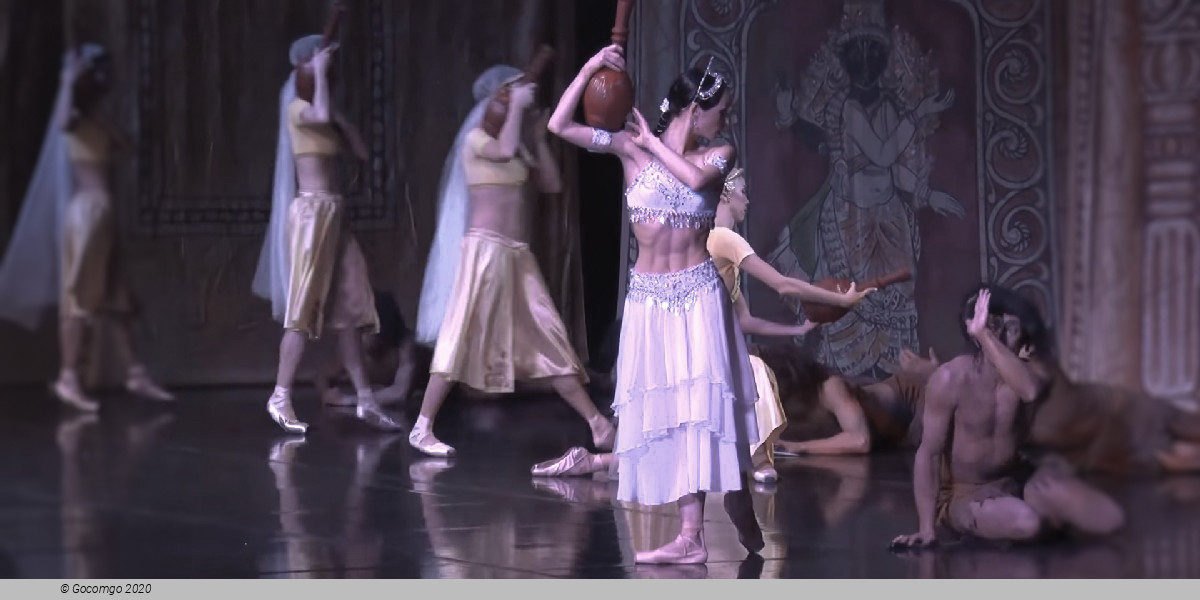
Nikia and other bayaderes give the fakirs water from the sacred pool. Imperceptibly Magedaveya tells Nikia that Solor will come to see her. The bayadere is happy.

It is getting dark. Nikia comes to meet her beloved. Their secret rendezvous is guarded by the fakir. But the High Brahmin manages to overhear the conversation of the sweethearts.

Solor proposes that they elope. The bayadere agrees, but first she wants him to vow fidelity to her at the sacred fire. Solor takes the oath. The High Brahmin is infuriated. He appeals to the godsand demands punishment. His revenge will be terrible.

Next morning the rajah Dugmanta, head of the principality, tells his daughter Gamzatti that she will see her fiance that day.
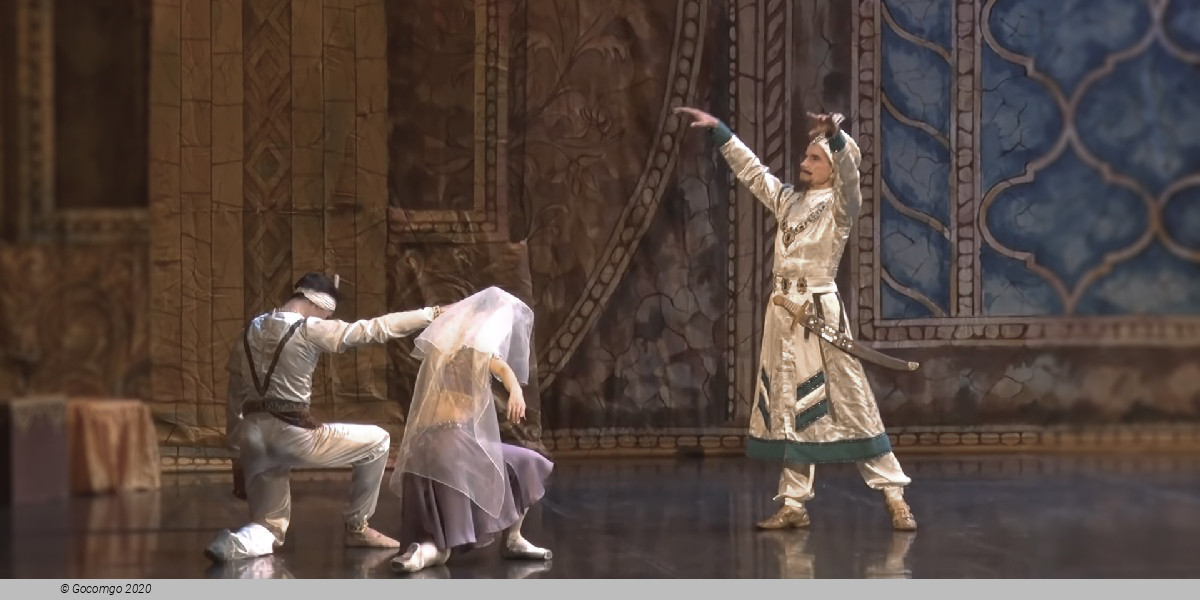
The rajah sends for the fiance. It is the brave warrior Solor. The rajah shows Solor his beautiful daughter and proclaims them bride and groom. The warrior is struck by Gamzatti’s beauty. But heremembers the bayadere, his vow to her, and is thrown into confusion.

It is time to hold the ceremony of consecrating Gamzatti’s betrothal. Nikia is invited to the palace for the ceremony.
The High Brahmin arrives. He wants to tell the rajah a secret. Dugmanta sends everybody away. Gamzatti feels that the High Brahmin’s arrival is somehow connected with her forthcoming marriage andeavesdrops on the Brahmin’s conversation with her father.

The High Brahmin tells the rajah about Solor’s love for Nikia. Dugmanta is infuriated but doesn’t change his mind to give his daughter in marriage to Solor. The bayadere, who made Solor take the oath, must die.The High Brahmin who had wanted to get rid of his rival, didn’t expect such a turn of events.
He threatens the rajah with punishment of the Gods for the bayadere’s death. But the rajah is unrelenting.

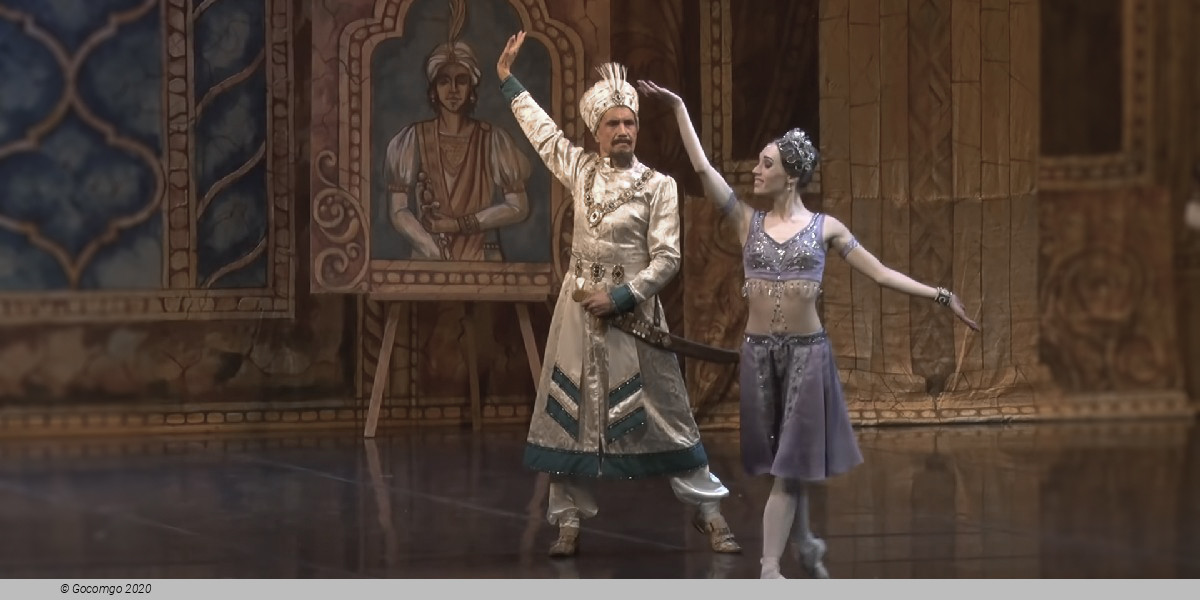
Gamzatti orders her slave to bring Nikia. She sees that the bayadere is very beautiful and can be a dangerous rival. The rajah’s daughter tells the bayadere about her forthcoming marriage and invitesher to dance at the feast. She deliberately shows her the portrait of her fiance Solor. Nikia protests: Solor loves only her and he made a vow of eternal fidelity. The rajah’s daughter demands that Nikia should give up Solor. But the bayadere would rather die than part with Solor. Gamzatti offers her jewels. Nikia throws them away with scorn. Nothing will make her part with her beloved. Sheraises her dagger in a rage. The slave stops her. But Gamzatti will never give her fiance back.

Act II
A sumptuous feast is being held on the occasion of Solor and Gamzatti’s engagement. The bayadere Nikia is supposed to entertain the guests with dances. She can’t hide her grief. Her eyes are fixed on her beloved Solor.

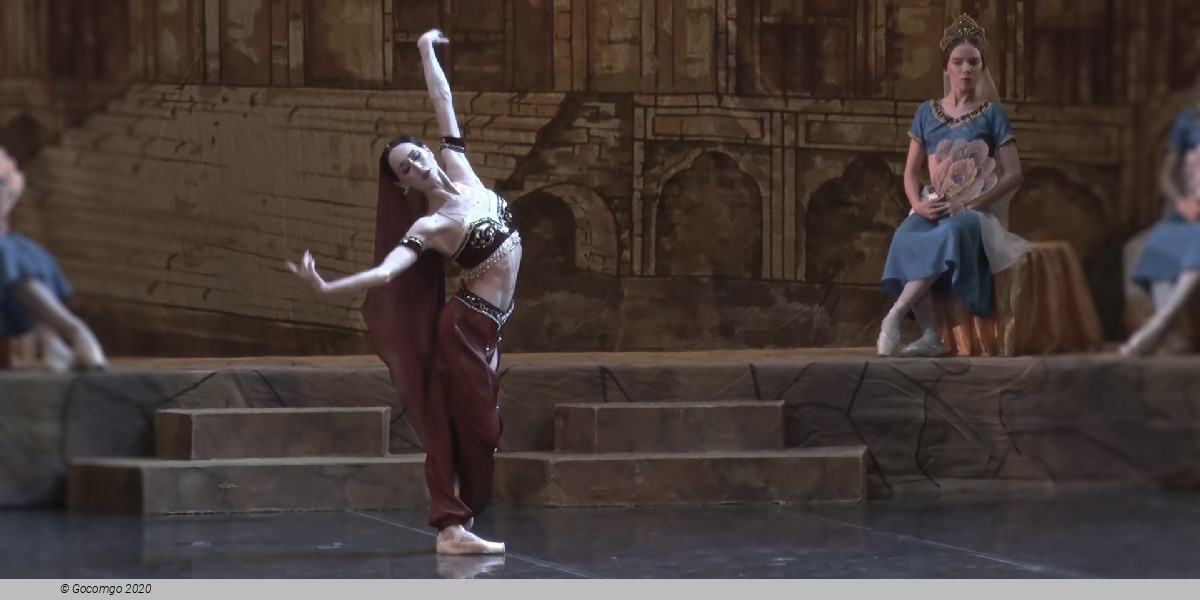
The fakir presents Nikia with a basket of flowers on behalf of Solor. The bayadere’s dance is filled with happiness. But suddenly a snake crawls out of the flowers and bites her fatally.
Nikia realizes that the rajah’s daughter is to blame for her death. The High Brahmin promises to save her life if she will love him. But the bayadere is faithful to her love for Solor. Nikia dies. Solor leaves the feast in despair.

Act III
Solor is inconsolable. He is gnawed by remorse. He enjoins the fakir to distract him from his grievous thoughts. Fascinated by the sacred dance, Solor sinks into the world of dreams.

Shadows appear to him out of the darkness. They are descending from mountains in a long file. Solor sees fair Nikia among them...
There is no more reality for Solor. He follows the shadow of fair Nikia...

Set in the Royal India of the past, La Bayadère is a story of eternal love, mystery, fate, vengeance, and justice.  The ballet relates the drama of a temple dancer (bayadère), Nikiya, who is loved by Solor, a noble warrior.  She is also loved by the High Brahmin, but does not love him in return, as she does Solor.

Act I

Scene I, Outside Temple in the Sacred Forest.

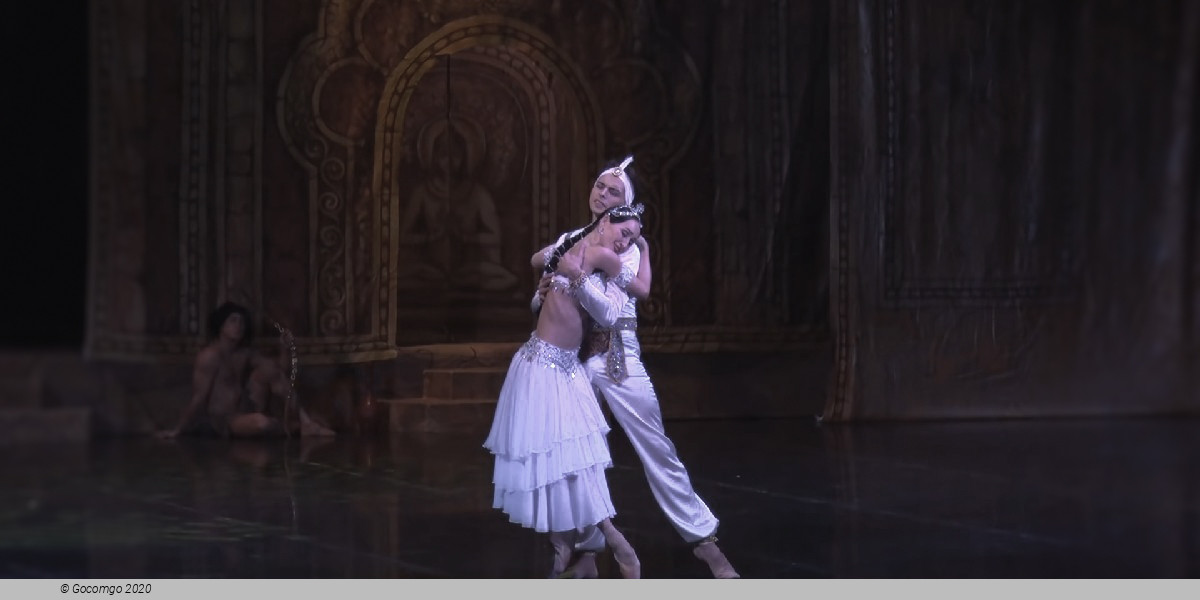
The High Brahmin, priests, and temple dancers are celebrating the Indian Ritual of Fire.  Nikiya, the most beautiful of the bayadères, has been chosen to be consecrated the lead temple dancer.  The High Brahmin declares his love for Nikiya, but is rejected by her.  Nikiya meets secretly with Solor later that evening.  They dance together and swear eternal love over the Sacred Fire, but are discovered by the jealous High Brahmin, who vows to kill Solor.

Scene II, A Room in the Palace.

The Rajah has decided to reward Solor’s valor and decrees that the warrior will marry his daughter, Gamzatti.  Gamzatti falls in love with Solor’s portrait, and when they meet, he is overwhelmed by her beauty.  Even though he has sworn eternal love to Nikiya, he cannot defy the wishes of the Rajah and agrees to marry Gamzatti.  The High Brahmin informs the Rajah of Nikiya and Solor’s secret love, hoping that the Rajah will do away with Solor.  Instead, the Rajah decides to kill Nikiya.

This conversation is overhead by Gamzatti, who summons Nikiya to her rooms and attempts to bribe Nikiya to give up Solor.  Refusing, Nikiya frantically attempts to kill  Gamzatti.  Nikiya flees and Gamzatti swears to destroy her.

Scene III, The Garden of the Palace.

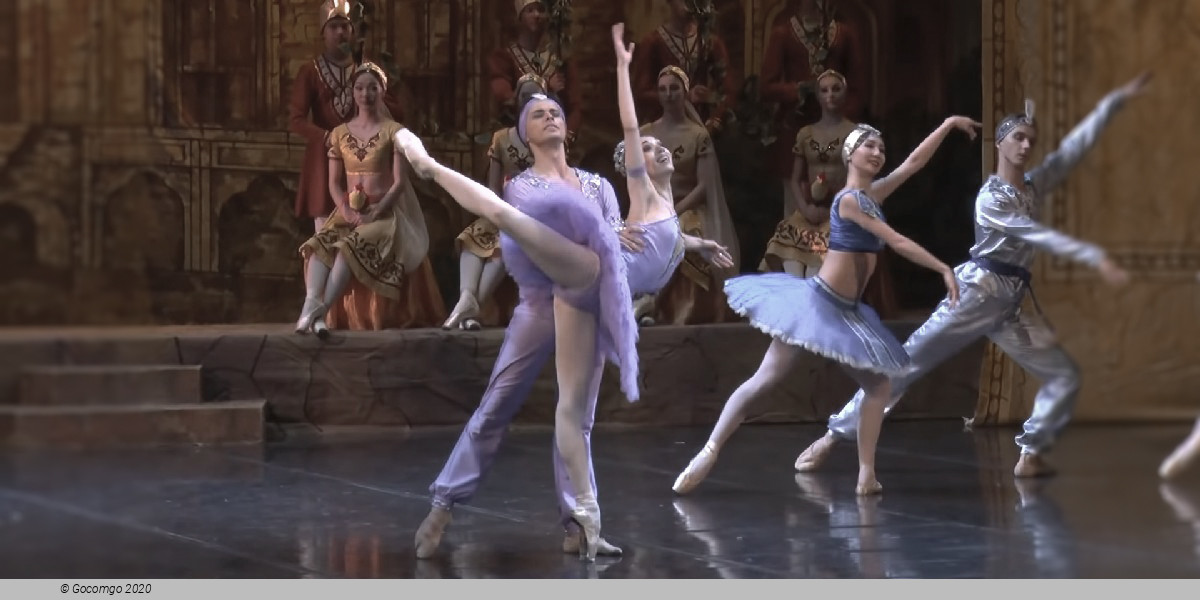
At the betrothal of Solor and Gamzatti, Nikiya is commanded to dance.  Gamzatti presents her with a basket of flowers that Nikiya believes to be from Solor, and which conceals a deadly snake.  Nikiya is bitten, and when Solor leaves with Gamzatti, she refuses the proffered antidote and dies.

Act II. The Tent of Solor.

Solor, grief‑stricken and under the influence of opium, dreams of being reunited with Nikiya in the Kingdom of the Shades.  Awakening, he realizes that he must prepare to marry Gamzatti.

Act III. The Temple.

The vision of Nikiya remains with Solor as the wedding ceremony begins at the Sacred Temple.  As Solor and Gamzatti say their vows and are blessed by the High Brahmin, the vengeance of the gods is unleashed, and the temple and all the celebrants are destroyed.  Nikiya and Solor are once again united in eternal love.

Venue Info

Teatro Real - Madrid
Location   Isabel II Square, s / n.

Teatro Real is a major opera house located in Madrid. Today the Teatro Real opera is one of the great theaters of Europe hosting large productions involving leading international figures in opera singing, musical direction, stage direction, and dance. Founded in 1818 and inaugurated on 19 November 1850, it closed in 1925 and reopened in 1966. Beginning in 1988 it underwent major refurbishing and renovation works and finally reopened in 1997 with a capacity of 1,746 seats. The theater offers visitors guided tours in several languages, including the auditorium, stage, workshops, and rehearsal rooms.

Founded by King Ferdinand VII in 1818, and after thirty-two years of planning and construction, a Royal Order on 7 May 1850 decreed the immediate completion of the "Teatro de Oriente" and the building works were finished within five months. The Opera House, located just in front of the Palacio Real, the official residence of the Queen who ordered the construction of the theatre, Isabel II, was finally inaugurated on 19 November 1850, with Donizetti's La Favorite.

The Teatro soon became one of the most prestigious opera houses in Europe. For over five decades it hosted the most renowned singers and composers of the time. In the early period, it saw famous opera singers such as Alboni, Frezzolini, Marietta Gazzaniga, Rosina Penco, Giulia Grisi, Giorgio Ronconi, Italo Gardoni, Mario de Candia and Antonio Selva among many others. In 1863, Giuseppe Verdi visited the theatre for the Spanish premiere of his La Forza del Destino. At its peak, in the last quarter of the 19th century, the Teatro hosted world renowned artists such as Adela Borghi, Marie Sasse, Adelina Patti, Christina Nilsson, Luisa Tetrazzini, Mattia Battistini, Julián Gayarre, Angelo Masini, Francesco Tamagno and Enrico Tamberlick. In 1925, the Ballets Russes of Diaghilev performed in the theatre with the presence of Nijinsky and Stravinsky.

From 1867 to 1925 the Teatro Real also housed the Madrid Royal Conservatory. In December of 1925 a Royal Order ordered its activities to be discontinued owing to the damage that the construction of the Metro de Madrid had caused to the building. The government set out to restore it and ordered numerous projects to be drawn out for its renovation, such as that from architect Urdanpilleta Flórez, who proposed a monumental remodeling of the building. However, financial difficulties prevented the completion of these projects and led to a simple restoration, sponsored by the Juan March Institute, and carried out first by the architect Manuel Gonzalez Valcárcel, and later by architects Miguel Verdú Belmonte and Francisco Rodriguez Partearroyo.

The theatre reopened in 1966 as a concert hall as well as the main concert venue for the Spanish National Orchestra and the RTVE Symphony Orchestra. The reopening was celebrated with a concert of the Spanish National Orchestra conducted by Rafael Frühbeck de Burgos, and the Orfeón Donostiarra. In 1969, the 14th Eurovision Song Contest was held at the theatre, featuring an onstage metal sculpture created by surrealist Spanish artist Salvador Dalí.

Important Info
Type: Ballet
City: Madrid, Spain
Starts at: 11:30
Acts: 3
Intervals: 2
Duration: 3h 15min
Top of page