
Teatro Real 17 June 2021 - Orlando furioso | GoComGo.com

Orlando furioso

Teatro Real, Main Auditorium, Madrid, Spain
All photos (3)
Select date and time
8 PM
Request for Tickets
Important Info
Type: Opera
City: Madrid, Spain
Starts at: 20:00
Acts: 3
Duration:
Sung in: Italian
Titles in: Spanish,English

E-tickets: Print at home or at the box office of the event if so specified. You will find more information in your booking confirmation email.

You can only select the category, and not the exact seats.
If you order 2 or 3 tickets: your seats will be next to each other.
If you order 4 or more tickets: your seats will be next to each other, or, if this is not possible, we will provide a combination of groups of seats (at least in pairs, for example 2+2 or 2+3).

Overview

Premiere at the Teatro Real

Concert version

At the pinnacle of chivalric literature - its roots in the Middle Ages - is Orlando furioso (1532), an epic poem by Ludovico Ariosto. It provided the groundwork for countless operas from Lully to Haydn, owing to an incomprehensible plot with enough episodes and characters to satisfy any librettist. Vivaldi’s opera brings together the romantic triangles that Handel would use, independently, years later in Alcina (1735) and Orlando (1733), namely: the obstacles put forward by the enchantress Alcina to interfere in the love between Ruggiero and Bradamante, and the frenzy of Orlando provoked by the love between Medoro and Angelica, whom Orlando adores as well. Although the composer claimed he had written 94 operas, barely twenty of these have survived as complete works, partially preserved or pastiches. Among the fortunate ones is Orlando furioso, premiered in the Teatro Sant’Angelo of Venice in 1727. It is a vocal feast which demands a small cast of first class voices, able to meet the demands of the score and give life to a fable of magic, love, jealousy and madness where good sense is restored only towards the end.

History
Premiere of this production: 31 October 1727, Teatro Sant'Angelo, Venice

Orlando, usually known in modern times as Orlando furioso, is an opera in three acts by Antonio Vivaldi to an Italian libretto by Grazio Braccioli, based on Ludovico Ariosto's epic poem Orlando Furioso (The Frenzy of Orlando). The first performance of the opera was at the Teatro San Angelo, Venice, in November 1727. It is to be distinguished from an earlier Vivaldi opera of 1714, Orlando furioso, set to much the same libretto, once thought to be a revival of a 1713 opera by Giovanni Alberto Ristori but now considered by Vivaldian musicologists to be a fully-fledged opera by Vivaldi himself.

Synopsis

Act 1
In a delightful garden in which two springs are seen, Medoro escapes from a shipwreck into the arms of his beloved Angelica. Alcina magically helps Medoro and he recounts how he was first captured, then shipwrecked. Orlando is jealous of Medoro, but Angelica lies and says Medoro is her brother.

Alcina is attracted to the knight Ruggiero. She uses her magic to make him forget Bradamante and love her instead. Bradamante discovers Ruggiero's "betrayal." She shows him the ring he gave her therefore breaking Alcina's spell. Ruggiero feels guilty for his actions.

Act 2
In a grove with green secluded spots, Astolfo reflects how he loves Alcina, but is tormented by her unfaithfulness.

Meanwhile, in a mountainous alpine region with a high, precipitous cliff, Angelica and Medoro swear their love and part ways. To rid herself of Orlando, Angelica sends him to fight a monster who guards —she claims— a vase containing an elixir of youth: the potion by which Medea revived the dying Aeson.[3] In fact, she is just trying to lure him into an enchanted cavern from which Alcina's spell makes escape impossible. Orlando enters defying the monster and is trapped. Realizing Angelica's faithlessness, however, he digs his way out despite the spell.

Angelica and Medoro marry in a countryside at the foot of a hill. They carve their vows on a nearby tree. Orlando finds the tree, and on reading the inscription, becomes so furious that he starts destroying the trees.

Act 3
The place is at the entrance hall before the temple of Hecate. Astolfo believes Orlando dead. With Ruggiero and Bradamante, he plots revenge against Alcina. The secret of Alcina's power lies in an urn with Merlin's ashes, which is locked in the temple of Hecate. They await Alcina's return.

Inside the temple of Hecate, Bradamante disguises herself as a man. Alcina falls in love with her. Orlando, still raving mad about the marriage of Angelica and Medoro, fights with the temple statues, inadvertently destroying Alcina's power.

In a deserted island. Alcina tries to attack the sleeping Orlando, but is prevented by Ruggiero and Bradamante. Astolfo returns to arrest Alcina. Orlando regains his reason and forgives Angelica and Medoro.

Venue Info

Teatro Real - Madrid
Location   Isabel II Square, s / n.

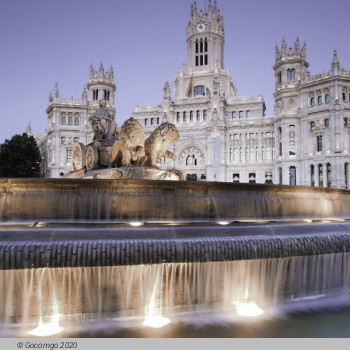
Teatro Real is a major opera house located in Madrid. Today the Teatro Real opera is one of the great theaters of Europe hosting large productions involving leading international figures in opera singing, musical direction, stage direction, and dance. Founded in 1818 and inaugurated on 19 November 1850, it closed in 1925 and reopened in 1966. Beginning in 1988 it underwent major refurbishing and renovation works and finally reopened in 1997 with a capacity of 1,746 seats. The theater offers visitors guided tours in several languages, including the auditorium, stage, workshops, and rehearsal rooms.

Founded by King Ferdinand VII in 1818, and after thirty-two years of planning and construction, a Royal Order on 7 May 1850 decreed the immediate completion of the "Teatro de Oriente" and the building works were finished within five months. The Opera House, located just in front of the Palacio Real, the official residence of the Queen who ordered the construction of the theatre, Isabel II, was finally inaugurated on 19 November 1850, with Donizetti's La Favorite.

The Teatro soon became one of the most prestigious opera houses in Europe. For over five decades it hosted the most renowned singers and composers of the time. In the early period, it saw famous opera singers such as Alboni, Frezzolini, Marietta Gazzaniga, Rosina Penco, Giulia Grisi, Giorgio Ronconi, Italo Gardoni, Mario de Candia and Antonio Selva among many others. In 1863, Giuseppe Verdi visited the theatre for the Spanish premiere of his La Forza del Destino. At its peak, in the last quarter of the 19th century, the Teatro hosted world renowned artists such as Adela Borghi, Marie Sasse, Adelina Patti, Christina Nilsson, Luisa Tetrazzini, Mattia Battistini, Julián Gayarre, Angelo Masini, Francesco Tamagno and Enrico Tamberlick. In 1925, the Ballets Russes of Diaghilev performed in the theatre with the presence of Nijinsky and Stravinsky.

From 1867 to 1925 the Teatro Real also housed the Madrid Royal Conservatory. In December of 1925 a Royal Order ordered its activities to be discontinued owing to the damage that the construction of the Metro de Madrid had caused to the building. The government set out to restore it and ordered numerous projects to be drawn out for its renovation, such as that from architect Urdanpilleta Flórez, who proposed a monumental remodeling of the building. However, financial difficulties prevented the completion of these projects and led to a simple restoration, sponsored by the Juan March Institute, and carried out first by the architect Manuel Gonzalez Valcárcel, and later by architects Miguel Verdú Belmonte and Francisco Rodriguez Partearroyo.

The theatre reopened in 1966 as a concert hall as well as the main concert venue for the Spanish National Orchestra and the RTVE Symphony Orchestra. The reopening was celebrated with a concert of the Spanish National Orchestra conducted by Rafael Frühbeck de Burgos, and the Orfeón Donostiarra. In 1969, the 14th Eurovision Song Contest was held at the theatre, featuring an onstage metal sculpture created by surrealist Spanish artist Salvador Dalí.

Important Info
Type: Opera
City: Madrid, Spain
Starts at: 20:00
Acts: 3
Duration:
Sung in: Italian
Titles in: Spanish,English
Top of page