
Komische Oper Berlin: The Bassarids Tickets | Event Dates & Schedule | GoComGo.com

The Bassarids Tickets

Komische Oper Berlin, Berlin, Germany
Important Info
Type: Opera
City: Berlin, Germany
Acts: 1
Sung in: English

E-tickets: Print at home or at the box office of the event if so specified. You will find more information in your booking confirmation email.

You can only select the category, and not the exact seats.
If you order 2 or 3 tickets: your seats will be next to each other.
If you order 4 or more tickets: your seats will be next to each other, or, if this is not possible, we will provide a combination of groups of seats (at least in pairs, for example 2+2 or 2+3).

Cast
Performers
Choose the date to see the peformers
Overview

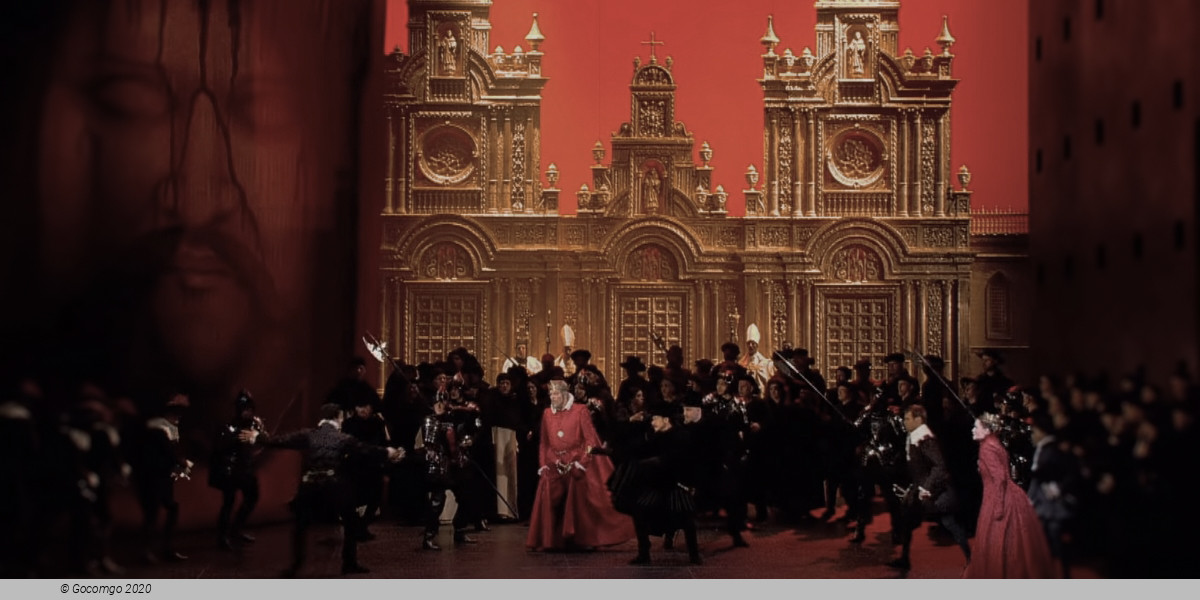
A blood-soaked tragedy about political demagoguery and the seduction of the masses. Hans Werner Henze’s The Bassarids tells the tale of the primordial human conflict between instinct and reason, between passionate excess and rational control. Following their success with Schönberg's Moses and Aron, Vladimir Jurowski and Barrie Kosky now take on a work of equal monumentality and archaism.

Young Pentheus has ascended to the throne of Thebes. Yet a stranger begins to undermine the king’s authority. In honor of the God Dionysus, he leads the people to intoxicating revelries devoted to pleasure and lust. More and more people join him, including Pentheus’ own mother Agaue. The king tries in vain to fight the power of instinct with reason. Finally, he wants to get his own impression and, disguising himself as a woman, joins the mass. In the excesses of a nightly orgy, he is brutally killed by his own mother who mistakes him for a wild animal. The next morning, she realizes she is holding her son’s head in her arms. The stranger reveals himself to be Dionysus and demands absolute, unconditional worship. One of the most important post-war German composers, Henze employed a gigantic orchestral machinery to set this timeless material to music. Taking structural orientation from the symphonic form, the score juxtaposes in four movements two opposing musical spheres representing Dionysus and Pentheus. In Barry Kosky’s production, the orchestra becomes the scene of battle for the antagonistic principles, breaking the physical boundaries of the orchestra pit and pressing onto the stage, where it becomes both witness and accomplice in the events unfolding.

History
Premiere of this production: 06 August 1966, Salzburg

The Bassarids (in German: Die Bassariden) is an opera in one act and an intermezzo, with music by Hans Werner Henze to an English libretto by W. H. Auden and Chester Kallman, after Euripides's The Bacchae. The conflict in the opera is between human rationality and emotional control, represented by the King of Thebes, Pentheus, and unbridled human passion, represented by the god Dionysus.

Synopsis

The setting is ancient Thebes. Prior to the opera, Dionysus has stated that he intends to revenge himself upon Agave and the women of Thebes because they have denied his divinity.

At the start of the opera, Cadmus, King of Thebes, has abdicated his throne in favour of his grandson Pentheus. Pentheus has learned of the cult of Dionysus, which involves wild and irrational revelry. Pentheus plans to ban the cult from his city. A stranger arrives in town and seduces the citizens into increasingly frenetic celebration of the god Dionysus. Because Pentheus is unaware of his own irrational, "Dionysiac" impulses, or tries to suppress them, Dionysus can entrance Pentheus and intrude upon his nature to the point that Pentheus disguises himself as a woman, and goes to Mount Cytheron, where the revelry is occurring. In the course of events, the spell over the citizens extends to Agave, Pentheus' mother, and Autonoe, Pentheus' sister. Pentheus is killed and torn to pieces, and his city brought to ruin. Without realising it, Agave cradles the severed head of her son in her arms. The Stranger is revealed to be Dionysus himself.

Venue Info

Komische Oper Berlin - Berlin
Location   Behrenstraße 55-57

The Komische Oper Berlin is a German opera company based in Berlin. The company produces opera, operetta and musicals.

The opera house is located on Behrenstraße, just a few steps from Unter den Linden. Since 2004, the Komische Oper Berlin, along with the Berlin State Opera, the Deutsche Oper Berlin, the Berlin State Ballet, and the Bühnenservice Berlin (Stage and Costume Design), has been a member of the Berlin Opera Foundation.

The theatre was built between 1891 and 1892 by architects Ferdinand Fellner and Hermann Helmer for a private society. It first opened on 24 September 1892 as "Theater Unter den Linden" with Adolf Ferron's operetta Daphne and Gaul and Haßreiter's ballet Die Welt in Bild und Tanz.

The theatre was primarily a vehicle for operetta, but was also used for various other events and balls. Around 800 people could be seated in the stalls, and the balconies and various en-suite dinner rooms housed about a further 1,700 seats. Its directors went bankrupt in 1896 and the theatre was forced to close its doors.

On 3 September 1898 the theatre was reopened as Metropol-Theater with Julius Freund's revue Paradies der Frauen. It then grew to become one of Berlin's most famous and successful variety theatres. During the 1920s and early 1930s, it was leased by the brothers Alfred and Fritz Rotter. Under their management, it saw the premieres of two operettas by Franz Lehár - Friederike (opera) in 1928 and Das Land des Lächelns in 1929, both starring Richard Tauber. However, due to a decline of variety and music hall entertainment the theatre was again closed in 1933.

In 1934 the theatre was nationalised and renamed Staatliches Operettentheater. It operated as part of the Nazi Kraft durch Freude entertainment and leisure programmes. During World War II, the auditorium was damaged by Allied bombing on 7 May 1944. The façade, entrance hall, and auditorium ceiling murals were destroyed by bombs on 9 March 1945.

After the war, the theatre was in East Germany, being that the building was in the eastern part of Berlin. Following repair works and provisional rebuilding, the theatre reopened on 23 December 1947, as the Komische Oper with Johann Strauss's operetta Die Fledermaus.

The 1950s saw various further alterations and extensions. The theatre was completely rebuilt in 1965/1966 by Architektenkollektiv Kunz Nierade, adding functional extensions and giving the theatre a completely new exterior. The theatre reopened again on 4 December 1966, with Mozart's Don Giovanni. The auditorium underwent further restoration in 1986, and the stage technology was further modernised by 1989. Today the theatre seats 1,270.

In 1947, Walter Felsenstein founded and led the resident opera company, the Komische Oper, until his death in 1975. Götz Friedrich was an assistant to Felsenstein at the company. Joachim Herz became general director after Felsenstein's death and served until 1981. Subsequently, Harry Kupfer directed the company for 21 seasons, until 2002. The company specializes in German language productions of opera, operetta and musicals. In 2007 the company won, jointly with Oper Bremen, the "Opera house of the year" award by the German magazine Opernwelt. From 2002 to 2012, the company's chief director and Intendant was Andreas Homoki. In June 2008, the company announced the appointment of Barrie Kosky to succeed Homoki as its next Intendant, as of the 2012/2013 season. In October 2014, his contract with the company was extended through 2022. Since 2005, the company's managing director has been Susanne Moser.

From 1966 to 2004, the theatre was also home to a resident ballet company – first as the "Tanztheater der Komischen Oper", and then from 1999 as "BerlinBallett – Komische Oper". In 2004, due to budgetary problems, the separate ballet companies of Berlin's three opera houses were merged into a single company called the Staatsballett Berlin.

Past General Music Directors (GMD) of the company have included Kurt Masur, Rolf Reuter, Yakov Kreizberg, Kirill Petrenko, Carl St.Clair, and Patrick Lange. Since 2012, the GMD of the company is Henrik Nánási. Nánási is scheduled to conclude his tenure at the end of the 2017-2018 season. In May 2017, the company announced the appointment of Ainārs Rubiķis as its next GMD, effective with the 2018-2019 season, with an initial contract of 3 seasons.

Important Info
Type: Opera
City: Berlin, Germany
Acts: 1
Sung in: English

E-tickets: Print at home or at the box office of the event if so specified. You will find more information in your booking confirmation email.

You can only select the category, and not the exact seats.
If you order 2 or 3 tickets: your seats will be next to each other.
If you order 4 or more tickets: your seats will be next to each other, or, if this is not possible, we will provide a combination of groups of seats (at least in pairs, for example 2+2 or 2+3).

Top of page