
Teatro Alla Scala tickets 9 June 2027 - Don Quichotte | GoComGo.com

Don Quichotte

Teatro Alla Scala, Milan, Italy
All photos (7)
Select date and time
8 PM
From
US$ 236

E-tickets: Print at home or at the box office of the event if so specified. You will find more information in your booking confirmation email.

You can only select the category, and not the exact seats.
If you order 2 or 3 tickets: your seats will be next to each other.
If you order 4 or more tickets: your seats will be next to each other, or, if this is not possible, we will provide a combination of groups of seats (at least in pairs, for example 2+2 or 2+3).

Important Info
Type: Opera
City: Milan, Italy
Starts at: 20:00
Acts: 5

E-tickets: Print at home or at the box office of the event if so specified. You will find more information in your booking confirmation email.

You can only select the category, and not the exact seats.
If you order 2 or 3 tickets: your seats will be next to each other.
If you order 4 or more tickets: your seats will be next to each other, or, if this is not possible, we will provide a combination of groups of seats (at least in pairs, for example 2+2 or 2+3).

Cast
Performers
Conductor: Bertrand de Billy
Mezzo-Soprano: Gaëlle Arquez (Dulcinea)
Bass-Baritone: Alex Esposito (Don Quichotte)
Baritone: Giulio Mastrototaro (Sancho Panza)
Choir: Teatro alla Scala Chorus
Creators
Composer: Jules Massenet
Director: Damiano Michieletto
Librettist: Henri Caïn
Dramaturge: Miguel de Cervantes
Overview

Never before performed at La Scala, Don Quichotte is Massenet’s penultimate opera, based on Cervantes’ novel as filtered through a theatrical work by Jacques Le Lorrain, and premiered in Monte Carlo two years before the composer’s death.

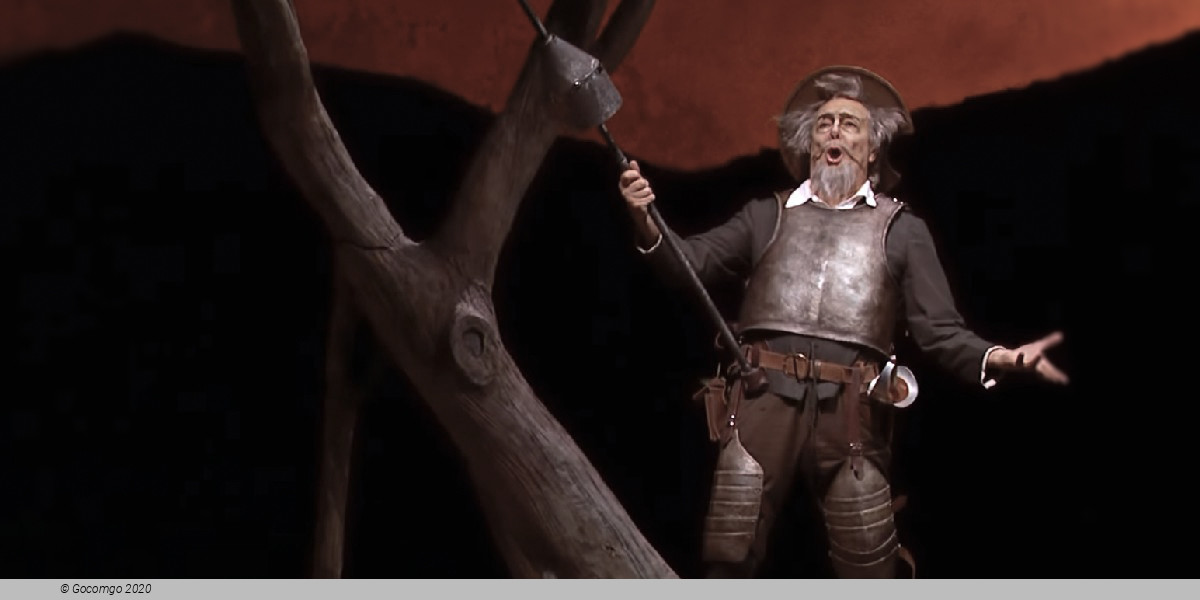
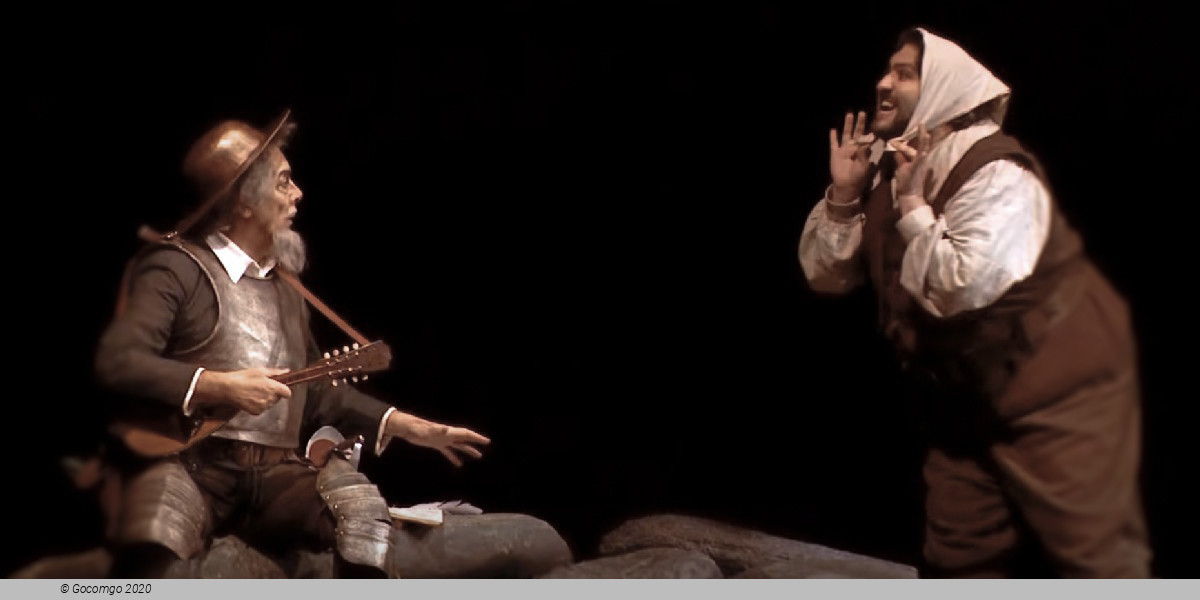
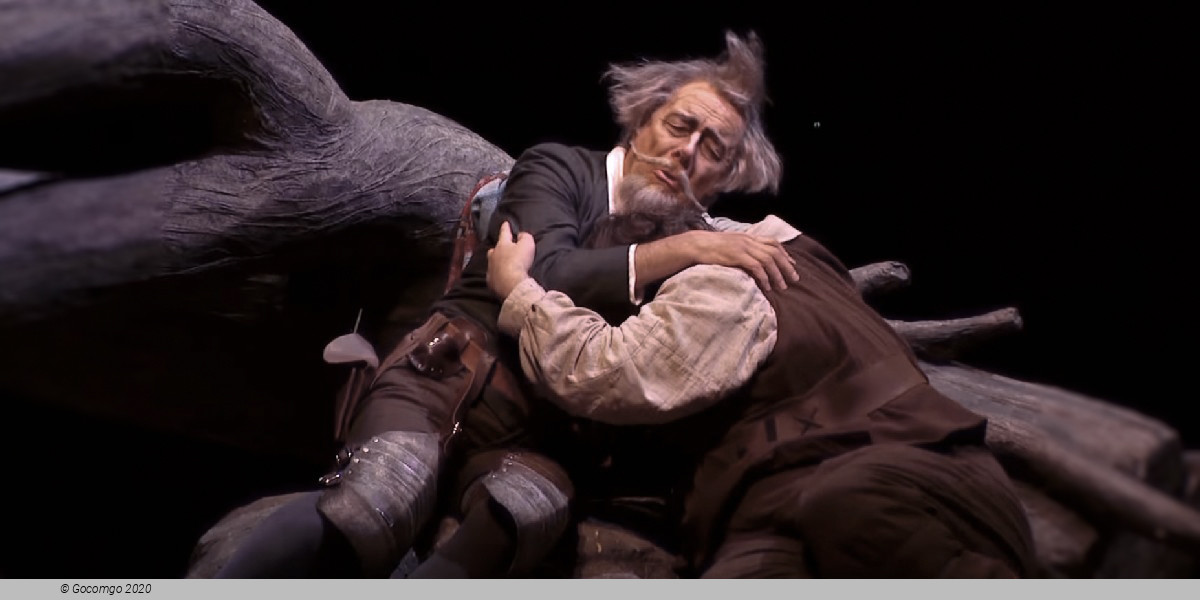
Damiano Michieletto imagines the story as an apologue about the loss of illusions and the social isolation of the dreamer, placing the three acts in three different moments: the 60s as the age of memories, the 90s as the manifestation of crisis, and today as the moment of death. The protagonist’s mind is crowded with images represented through video projections alternating scenes from his past with graphic representations of his obsessions. Alex Esposito lends his vocal and acting qualities to the protagonist hopelessly in love with the charismatic Gaëlle Arquez. In his final hour, only Sancho, portrayed by Giulio Mastrototaro, remains beside him, perhaps the only one who truly cared for him.

Teatro alla Scala New Production

Opéra de Paris Production

History
Premiere of this production: 19 February 1910, Opéra de Monte-Carlo

Don Quichotte (Don Quixote) is an opera in five acts by Jules Massenet to a French libretto by Henri Caïn. It was first performed on 19 February 1910 at the Opéra de Monte-Carlo.

Synopsis

Act 1
A square in front of Dulcinée's house

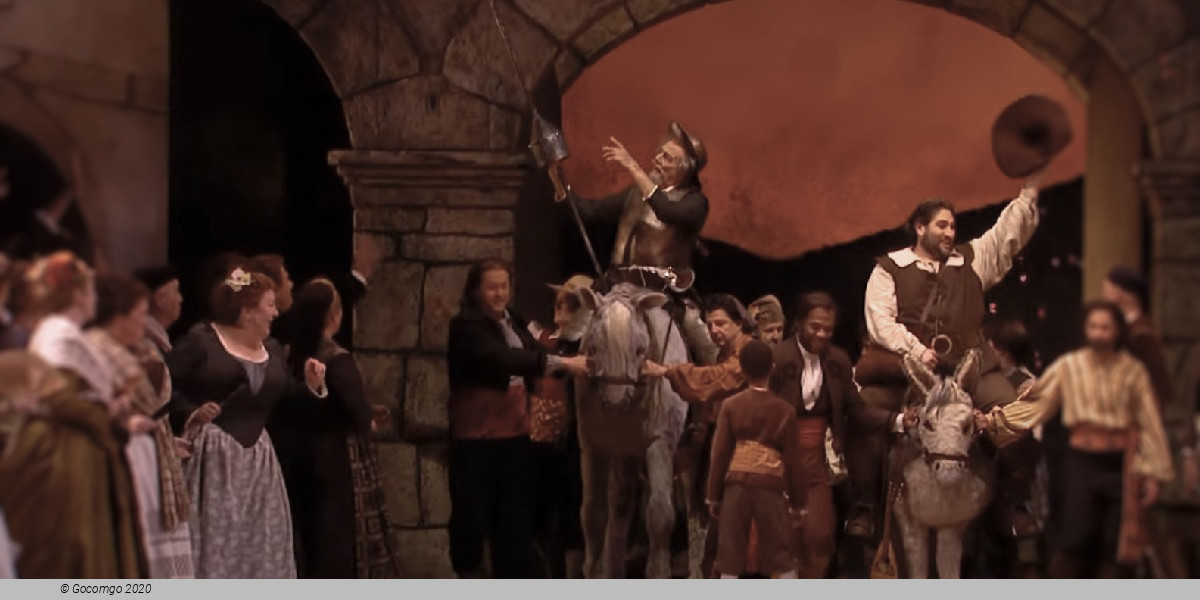
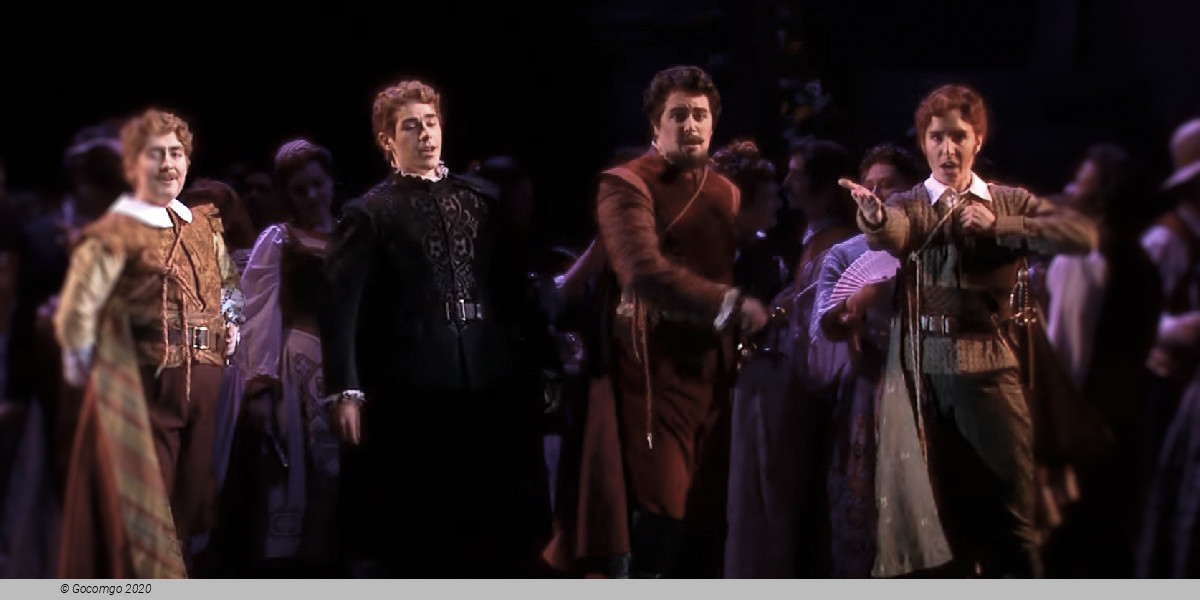
A festival is being celebrated. Four hopeful admirers of Dulcinée serenade her from the street. Dulcinée appears and explains philosophically that being adored is not enough, 'Quand la femme a vingt ans' ('When a woman is twenty'). She withdraws and a crowd, largely of beggars, acclaim the arrival of the eccentric knight Don Quichotte (riding on his horse Rossinante) and his comic squire Sancho Panza (on a donkey). Delighted by their attention, Don Quichotte tells a reluctant Sancho to throw them money. After the crowd disperse, Don Quichotte himself serenades Dulcinée, 'Quand apparaissent les étoiles' ('When the stars begin to shine') but he is stopped by Juan, a jealous admirer of the local beauty. A sword fight follows, interrupted by Dulcinée herself. She is charmed by Don Quichotte's antique attentions, chides Juan for his jealousy and sends him away. The old man offers her his devotion and a castle. She suggests instead that he might retrieve a pearl necklace of hers stolen by Ténébrun, the bandit chief. He undertakes to do so, and Dulcinée quickly rejoins her men friends.

Act 2
In the countryside

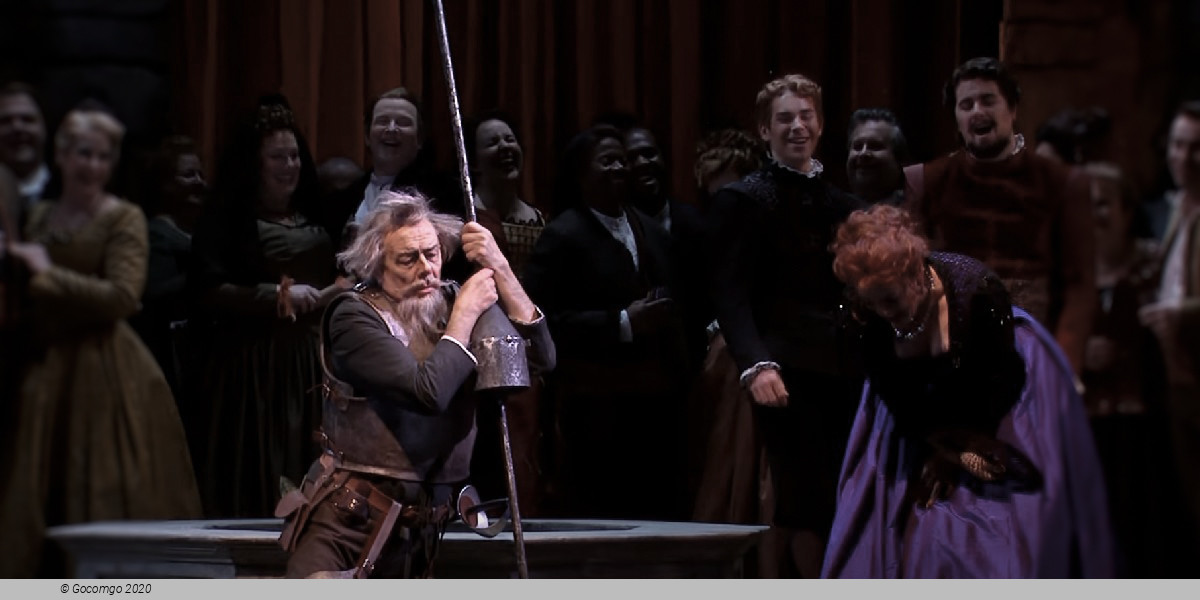
A misty morning, Don Quichotte and Sancho enter with Rossinante and the donkey. Don Quichotte is composing a love poem. Sancho delivers a grand tirade against their expedition, against Dulcinée, and against women in general. 'Comment peut-on penser du bien de ces coquines' ('How can anyone think anything good of those hussies'). The mists disperse revealing a line of windmills that Don Quichotte takes for a group of giants. To Sancho's horror, Don Quichotte attacks the first one, only to be caught up in one of the sails and hoisted up in the air.

Act 3
In the mountains

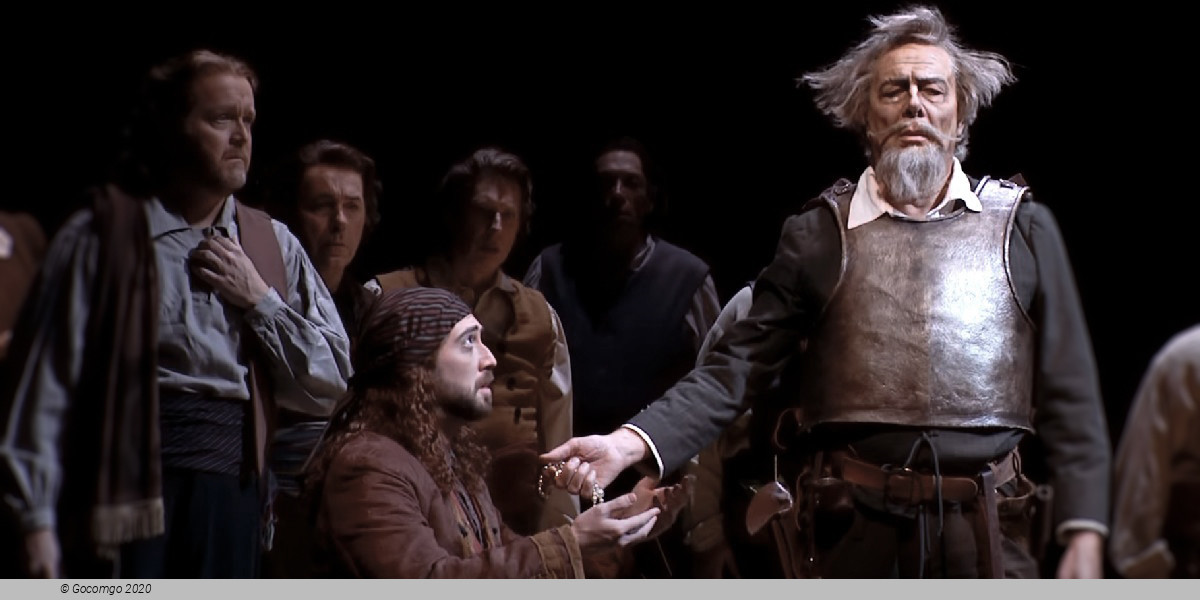
Dusk, Don Quichotte believes they are getting close to the bandits. Sancho goes to sleep while Don Quichotte stands guard. The bandits suddenly appear and after a brief fight take the knight prisoner. Sancho escapes. Surprised by the defiance of the old man, the bandits give him a beating and intend to kill him, however Don Quichotte's prayer 'Seigneur, reçois mon âme, elle n'est pas méchante' ('Lord receive my soul, it is not evil') moves Ténébrun, the bandit chief, to mercy. Don Quichotte explains his mission 'Je suis le chevalier errant' ('I am the Knight-errant'), and the necklace is returned to him. The bandits ask for the blessing of the noble knight before he leaves.

Act 4
The garden of Dulcinée's House

Music and dancing, a party is in progress, but Dulcinée is melancholy, 'Lorsque le temps d'amour a fui' ('When the time of love has gone'). Rousing herself, she snatches a guitar and sings 'Ne pensons qu'au plaisir d'aimer' ('Think just of the pleasures of love'). All retire to dinner. Sancho and Don Quichotte arrive. While waiting for Dulcinée, Sancho asks for his reward to which Don Quichotte responds with vague promises of an island, a castle, riches. Dulcinée and her party greet the knight and he returns the necklace to universal acclaim. However, when he asks her to marry him he is greeted with hysterical laughter. Taking pity, Dulcinée tells the others to leave, apologizes 'Oui, je souffre votre tristesse, et j'ai vraiment chagrin à vous désemparer' ('I share your sorrow and am truly sorry') but explains that her destiny, her way of life, is different from his. She kisses him on the forehead and leaves. But the company return to make fun of the old man. Sancho vigorously upbraids them, 'Riez, allez, riez du pauvre idéologue' ('Laugh, laugh at this poor idealist') and takes his master away.

Act 5
A mountain pass in an ancient forest

A clear starry night, Don Quichotte is dying. He remembers once promising Sancho an island as his reward, and offers him an isle of dreams, 'Prends cette île' ('Take that isle'). Nearing death, Don Quichotte looks up at a star shining brightly above and hears the voice of Dulcinée calling him to another world. Then he collapses as Sancho weeps over his body.

Venue Info

Teatro Alla Scala - Milan
Location   Via Filodrammatici, 2

Teatro Alla Scala is an opera house in Milan. Most of Italy's greatest operatic artists, and many of the finest singers from around the world, have appeared at La Scala. The theatre is regarded as one of the leading opera and ballet theatres globally. It is home to the La Scala Theatre Chorus, La Scala Theatre Ballet, La Scala Theatre Orchestra, and the Filarmonica della Scala orchestra.

The Teatro alla Scala was founded, under the auspices of the Empress Maria Theresa of Austria, to replace the Royal Ducal Theatre, which was destroyed by fire on 26 February 1776 and had until then been the home of opera in Milan. The cost of building the new theatre was borne by the owners of the boxes at the Ducal, in exchange for possession of the land on which stood the church of Santa Maria alla Scala (hence the name) and for renewed ownership of their boxes. Designed by the great neoclassical architect Giuseppe Piermarini, La Scala opened on 3 August 1778 with Antonio Salieri's opera L'Europa riconosciuta, to a libretto by Mattia Verazi.

With the advent of Rossini in 1812 (La pietra del paragone), the Teatro alla Scala was to become the appointed place of Italian opera seria: of its history dating back more than a century and of its subsequent tradition up till the present. The catalogue of Rossini's works performed until 1825 included: Il turco in Italia, La Cenerentola, Il barbiere di Siviglia, La donna del lago, Otello, Tancredi, Semiramide and Mosé. During that period the choreographies of Salvatore Viganò (1769-181) and of Carlo Blasis (1795-1878) also widened the theatre's artistic supremacy to include ballet.

An exceptional new season of serious opera opened between 1822 and 1825, with Chiara e Serafina by Gaetano Donizetti (1797-1848) and Il pirata by Vincenzo Bellini (1801-1835). The later operas of Donizetti performed at La Scala were (until 1850) Anna Bolena, Lucrezia Borgia, Torquato Tasso, La fille du régiment, La favorita, Linda di Chamonix, Don Pasquale, and Poliuto. These were followed (until 1836) by Bellini's I Capuleti e i Montecchi, Norma, La sonnambula, Beatrice di Tenda and I puritani.

In 1839 Oberto Conte di San Bonifacio inaugurated the cycle of operas by Giuseppe Verdi (1813-1901), the composer whose name is linked more than any other to the history of La Scala. After the dismal failure of Un giorno di regno, Nabucco was performed in 1842. It was the first, decisive triumph of Verdi's career. At the same time, the strong patriotic feelings stirred by Nabucco founded the "popularity" of opera seria and identified its image with the Scala.

Arturo Toscanini (1867-1957) became the artistic director and introduced radical reform into the theatre, both in its organisational aspects and in its relations with the public. Toscanini, one of the greatest conductors of all time, took up Verdi's musical inheritance and launched a tradition of interpretation that continued uninterruptedly and was renewed during the twentieth century. It was he who reappraised and regularly performed at the Scala the works of Richard Wagner (hitherto only belatedly and inadequately recognised). He also firmly extended the Scala's orchestral repertoire to include symphonic music.

In 1948 maestro Guido Cantelli (1920-1956) made his debut and established himself as one of the leading postwar conductors. Numerous opera performances productions (the Wagnerian cycle conducted in 1950 by Wilhelm Furtwängler, the Verdi repertoire by Victor De Sabata, etc), concerts (Herbert von Karajan, Dimitri Mitropoulos, Bruno Walter, etc), singers (Maria Callas, Renata Tebaldi, Giuseppe Di Stefano, Mario Del Monaco, etc), ballet performances (Margot Fonteyn, Serge Lifar, Maya Plissetskaya, Rudolf Nureyev), and productions (Luchino Visconti, Giorgio Strehler) belong not only to the history of the Scala, but to that of the history of musical theatre since the war.

In 1965 Claudio Abbado made his début at the Scala and in 1972 was named conductor of the Scala Orchestra. Until 1986 he directed among other works Il barbiere di Siviglia, Cenerentola, L'Italiana in Algeri by Rossini, Simon Boccanegra, Macbeth and Don Carlo by Verdi, the recent Al gran sole carico d'amore by Luigi Nono, and Pelléas et Mélisande by Claude Debussy. He also conducted numerous concerts. The chorus-master was Romano Gandolfi. In 1975 the ballet dancer Oriella Dorella debuted at La Scala. Among other contemporary composers, up till 1986 the Theatre continued to give works by Luciano Berio (La vera storia), Franco Donatoni (Atem) and Karlheinz Stockhausen (Samstag aus Licht).

In 1981 Riccardo Muti debuted at the Scala as an opera conductor (Mozart, Le nozze di Figaro). Giulio Bertola was appointed to direct the Chorus. In 1982 the Orchestra Filarmonica della Scala was established. In 1985 Alessandra Ferri made her debut at the Scala. In 1986 Riccardo Muti was appointed musical director. From 1989 to 1998 he reintroduced the best-loved works (Rigoletto, La traviata, Macbeth, La forza del destino) and numerous other titles by Verdi including Falstaff and Don Carlo.

In 1991 Roberto Gabbiani took over the directorship of the chorus. In 1997 La Scala was converted into a Foundation under private ownership, thus opening a decisive phase of modernisation.

On 7 December 2001 a new production of Otello, conducted by Muti, concluded the Verdi Year and, for the time being, performances at Piermarini’s original building in Piazza Scala. Major restoration and modernisation works of the Theatre began in January 2002.

The 2005-2006 Season, dedicated to the 250th anniversary of Mozart’s birth, was inaugurated by Idomeneo conducted by Daniel Harding. The 2006/07 season saw the return on 7 December of an opera by Verdi, Aida, conducted by Riccardo Chailly, and the launch of the Celebrations for the 50th Anniversary of Arturo Toscanini’s Death. On 7 December 2007 the 2007/08 season opened with Tristan und Isolde conducted by Daniel Barenboim. The opera marked the beginning of a closer collaboration between the Teatro alla Scala and the Israeli-Argentinian Maestro.

Important Info
Type: Opera
City: Milan, Italy
Starts at: 20:00
Acts: 5
Top of page